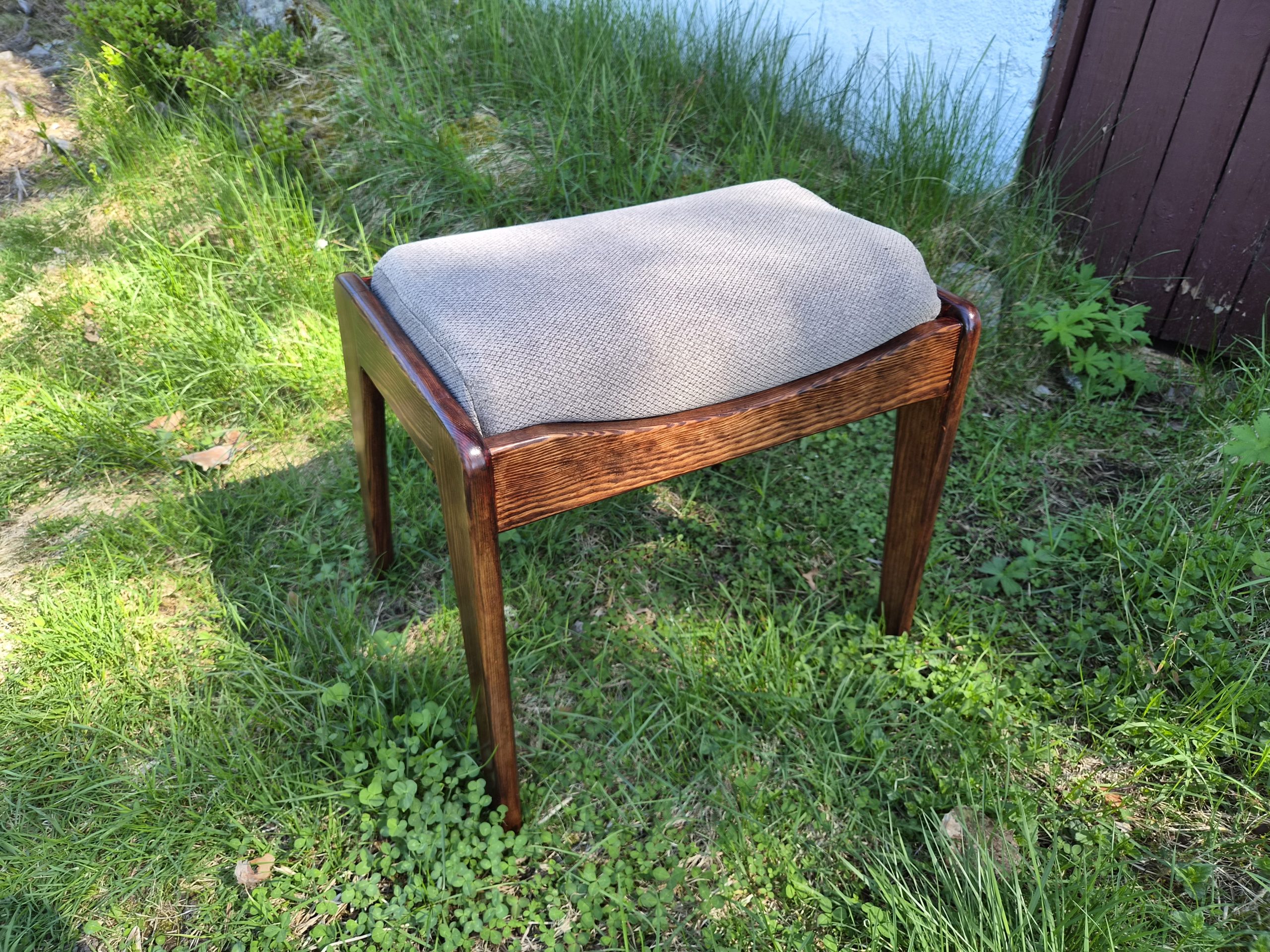
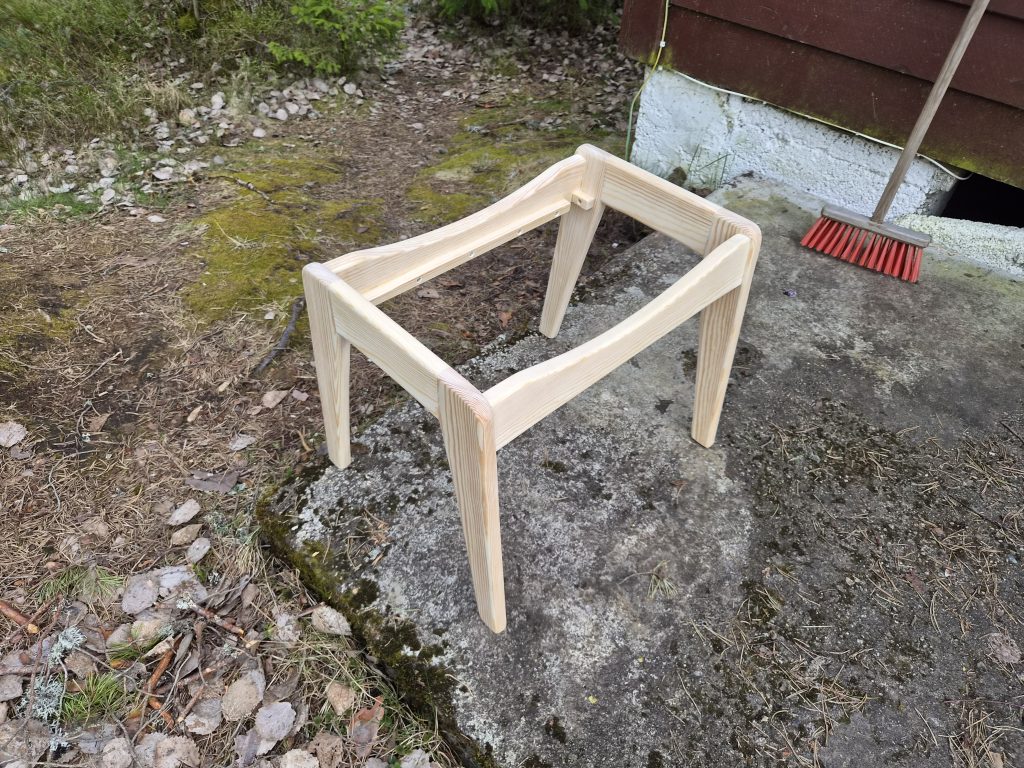
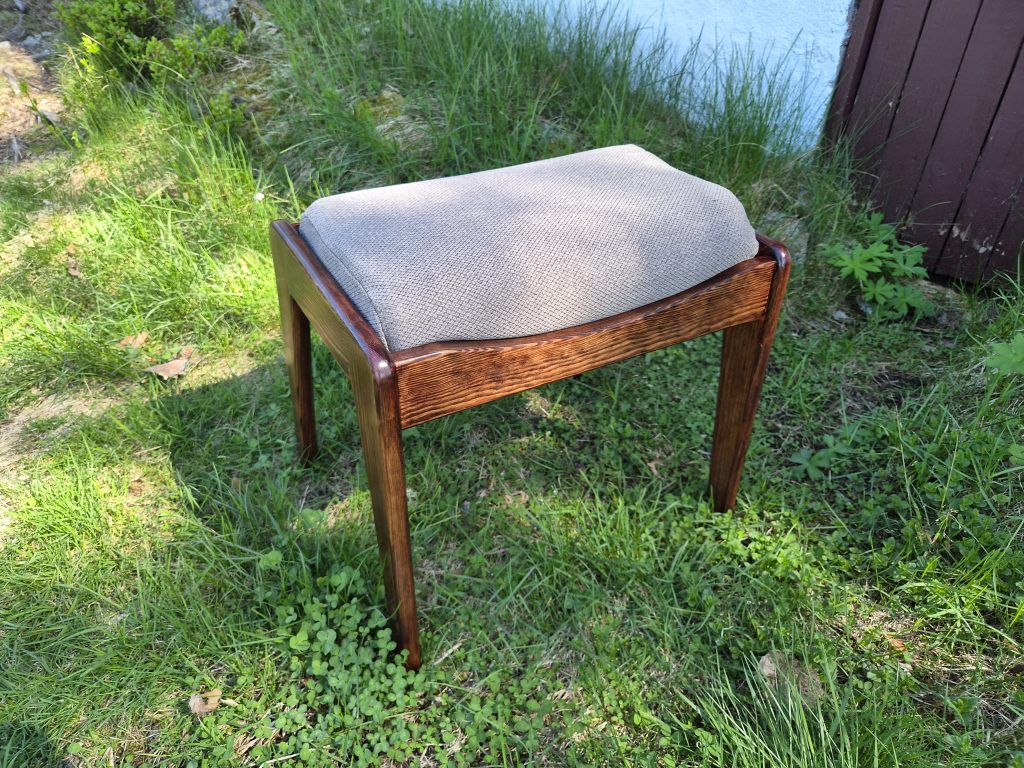
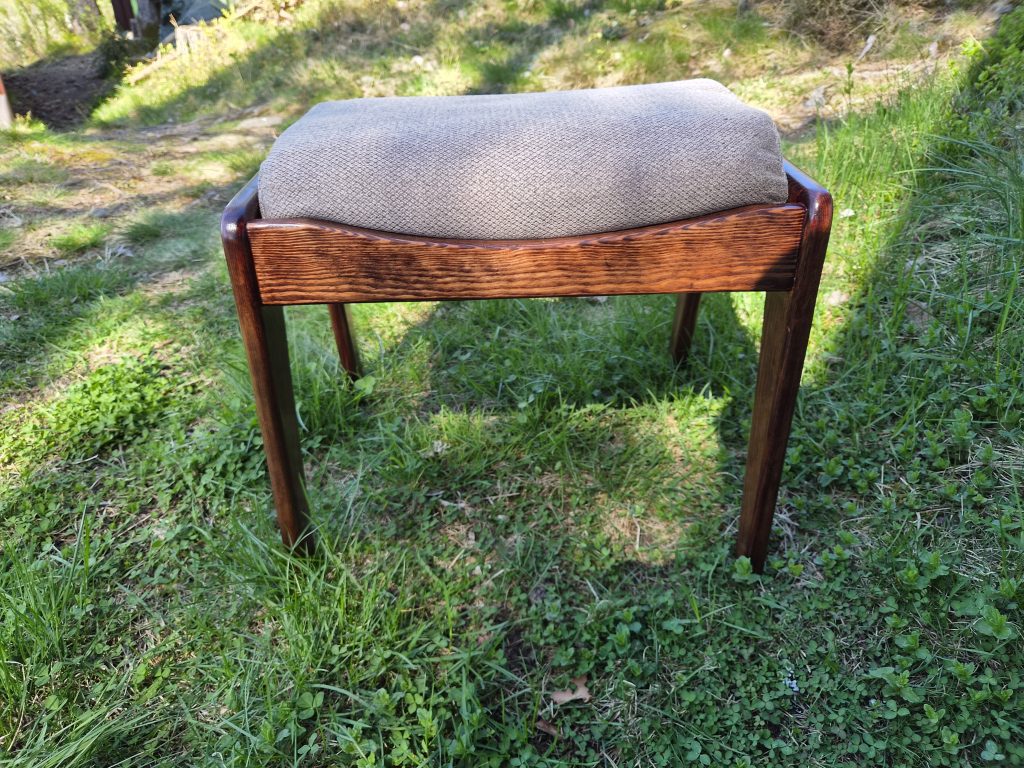
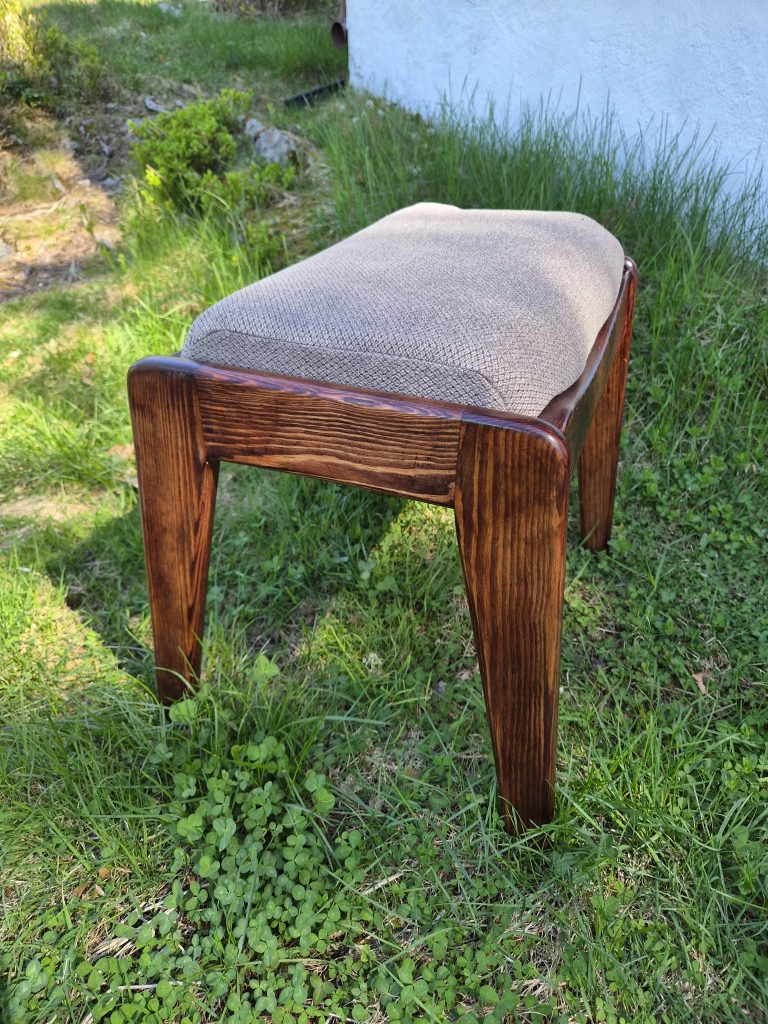
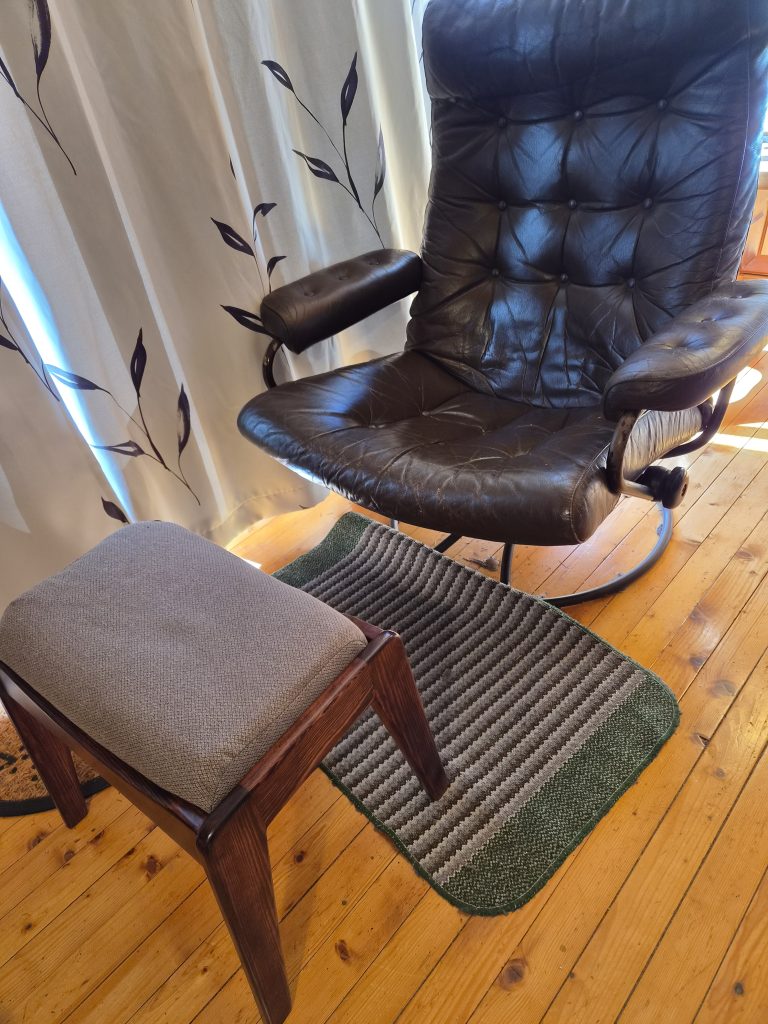
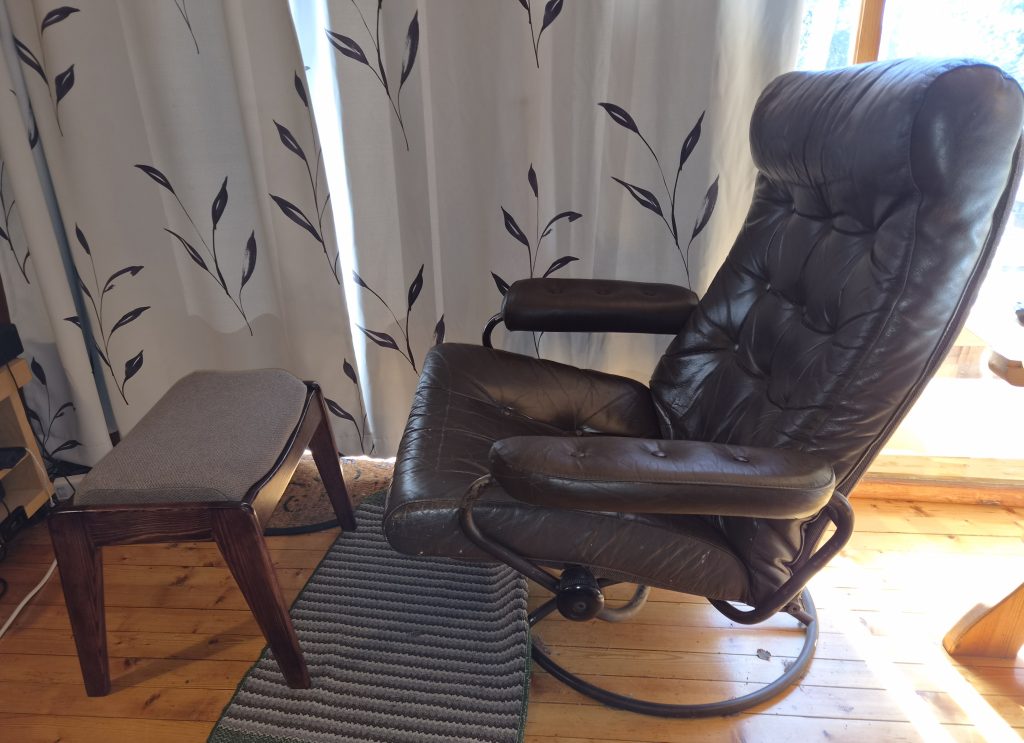
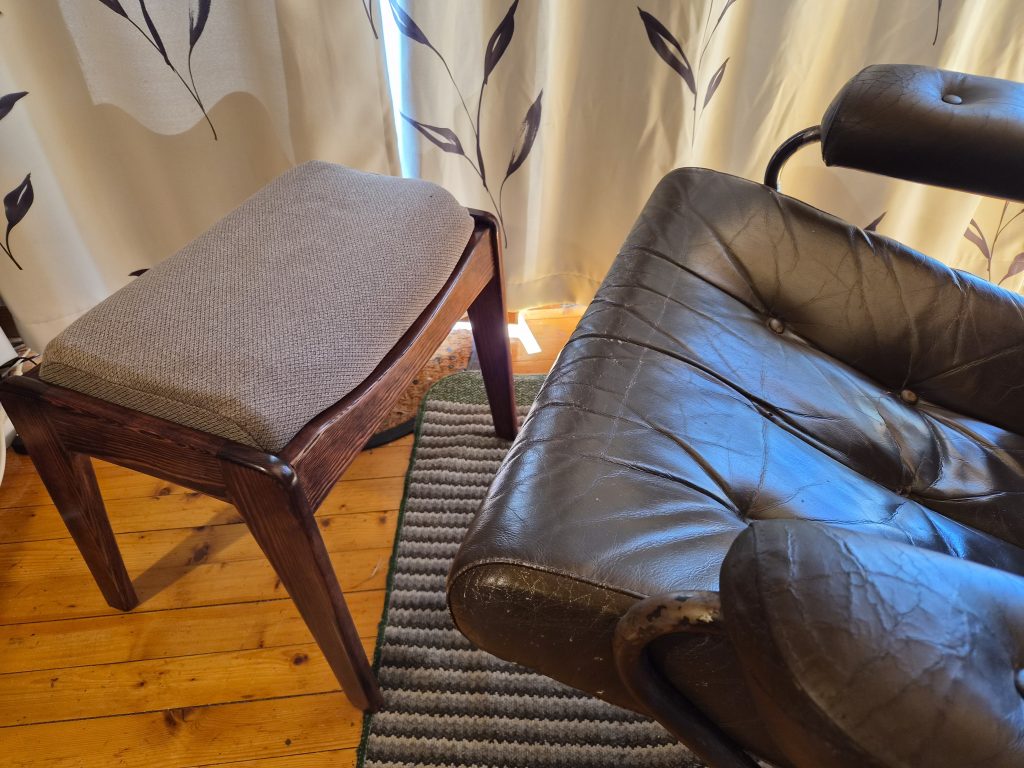
After finally getting a place to do some woodworking, I wanted to make some small piece of furniture as a test to myself of what I was able to make. One of the things I wish I had was a footrest to our old recliner at the cabin, and as it was quite simple in its design, I thought it was a nice thing to make. I only used hand tools for this project, except for the sewing machine for the pillow.
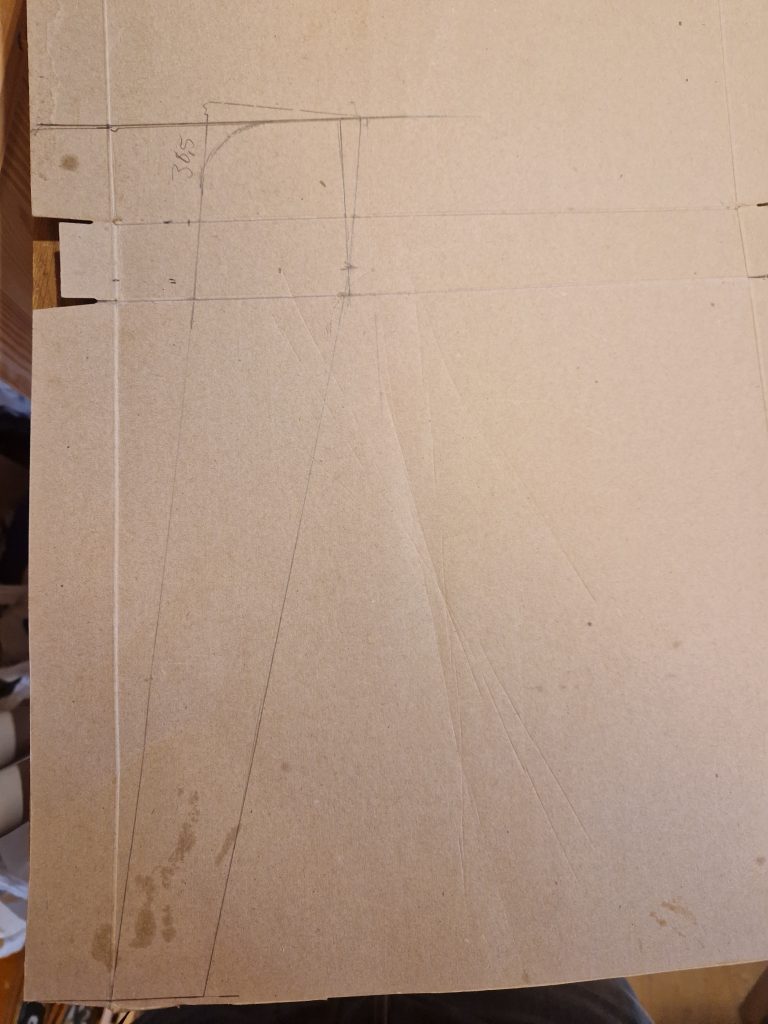
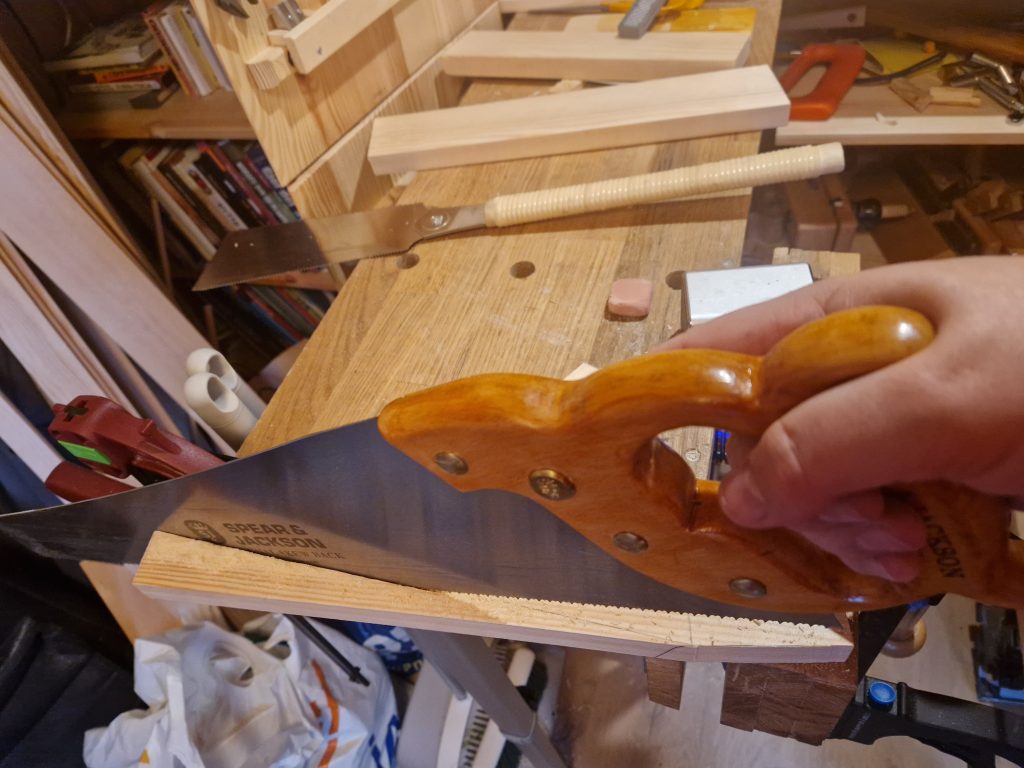
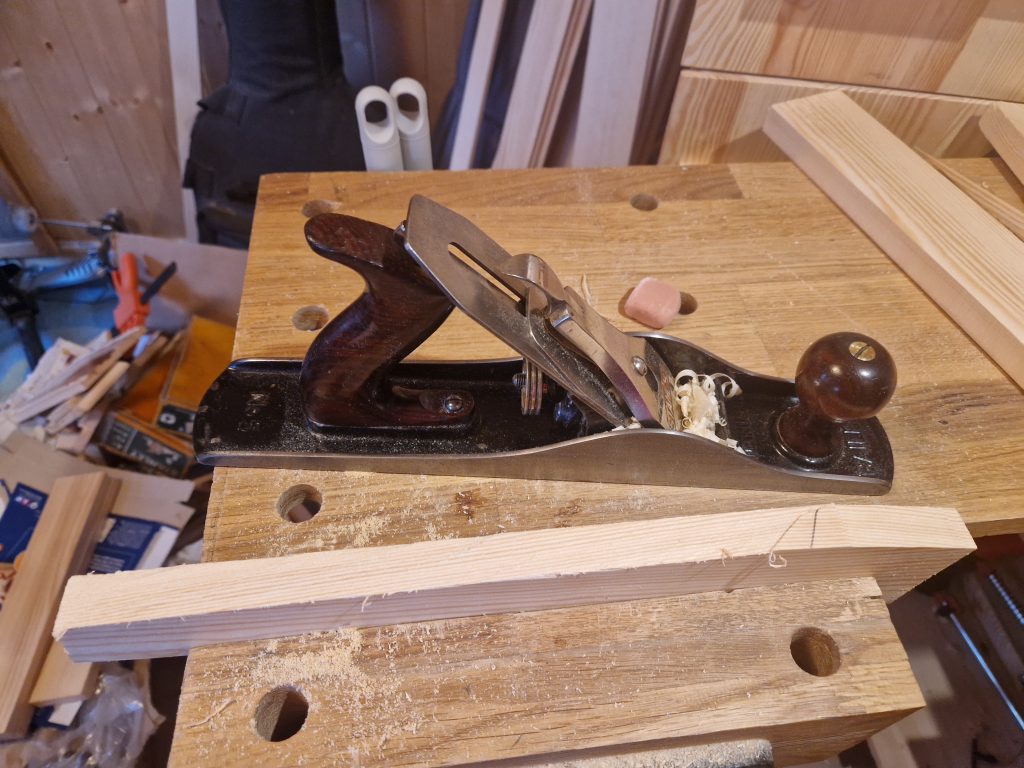
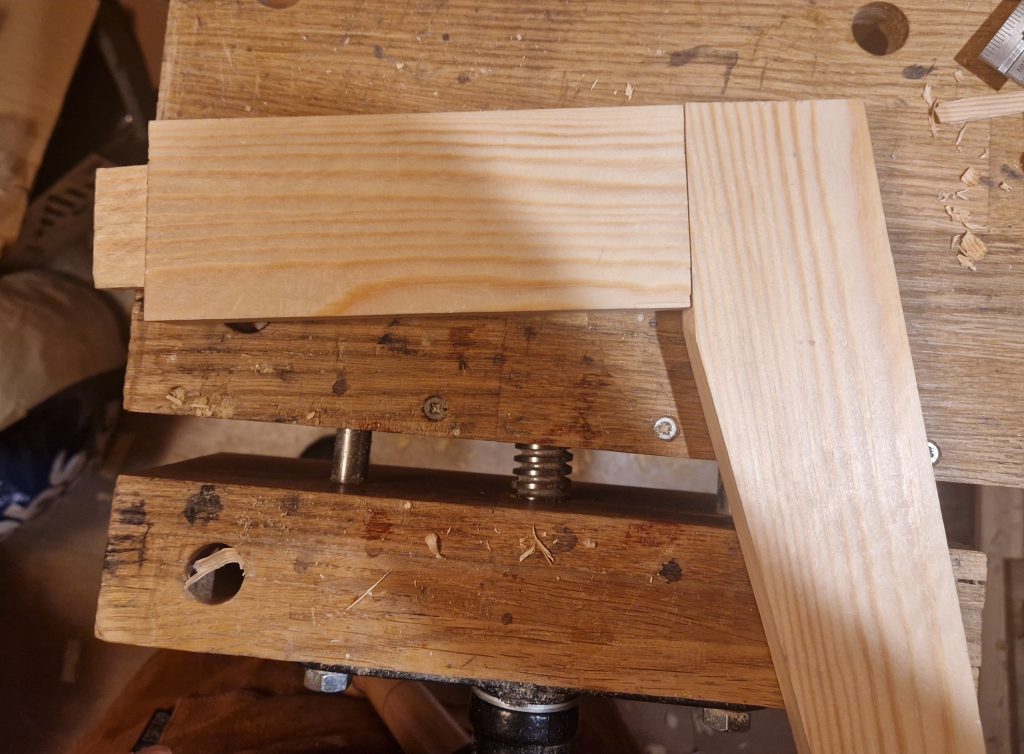
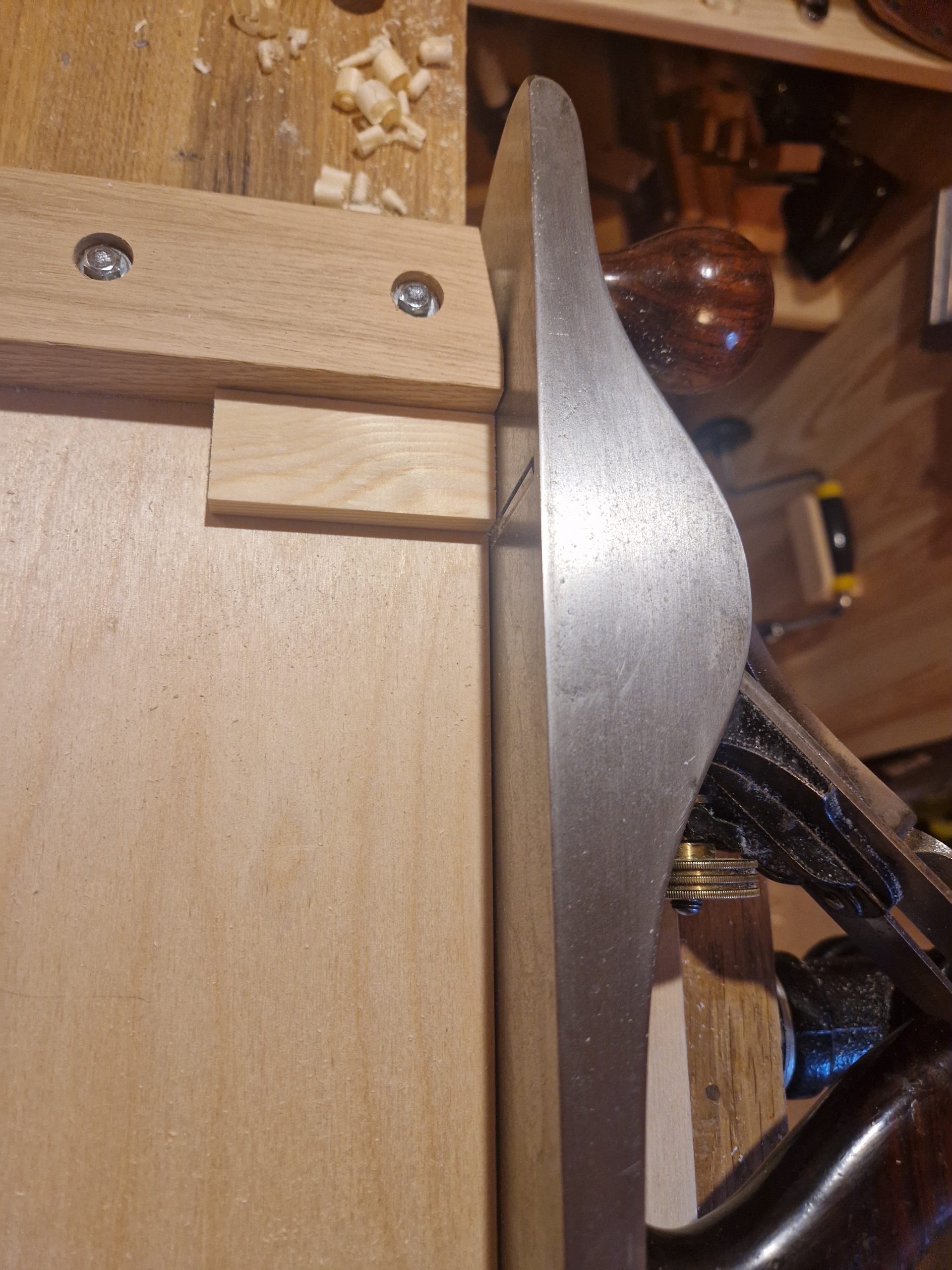
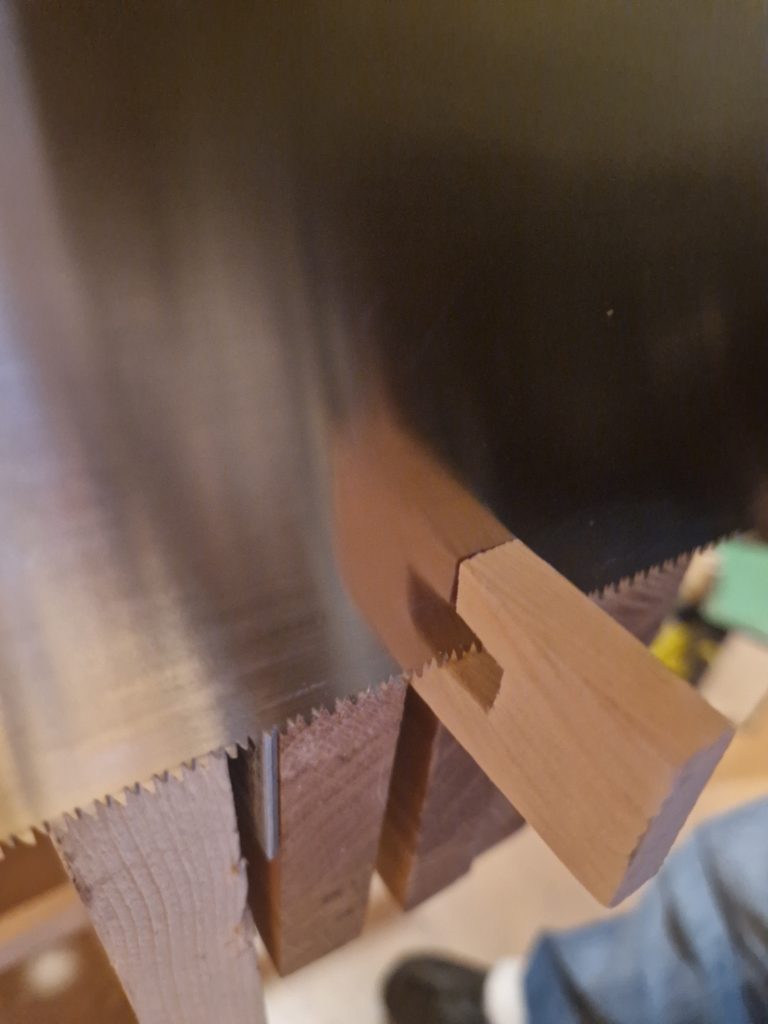
The design is my own. I started by drawing the outline of the side of it on a piece of cardboard from a pizza box. You use what you have, right? The legs were cut with a panel saw, and I used a Jack plane to smoth the cut
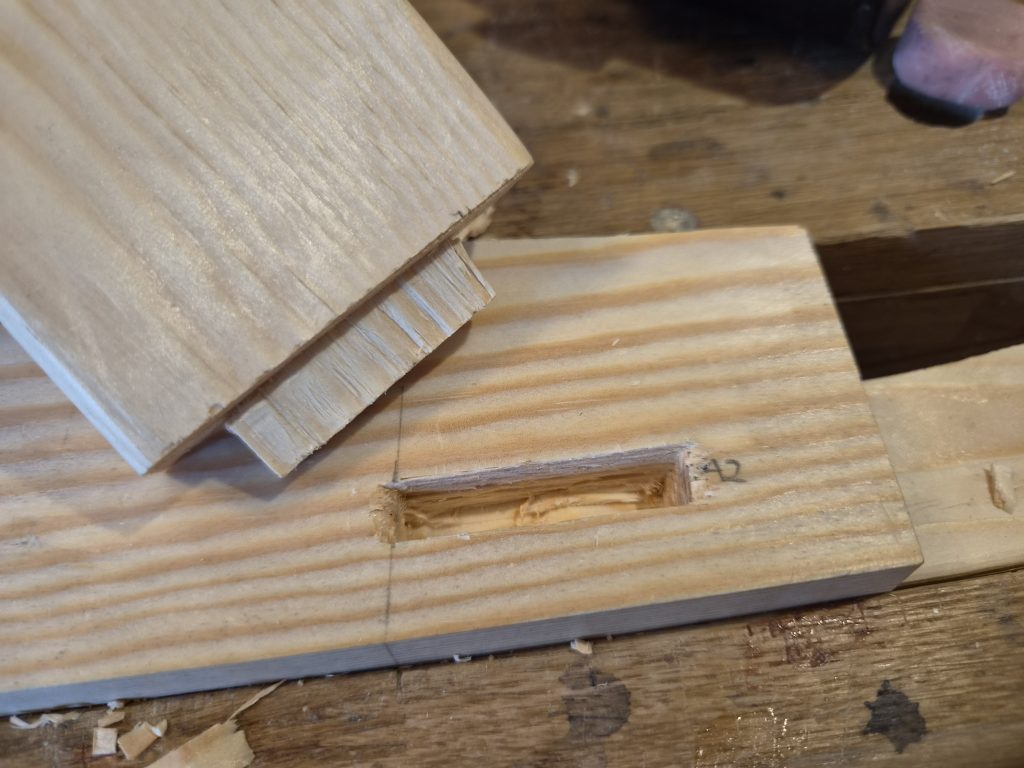
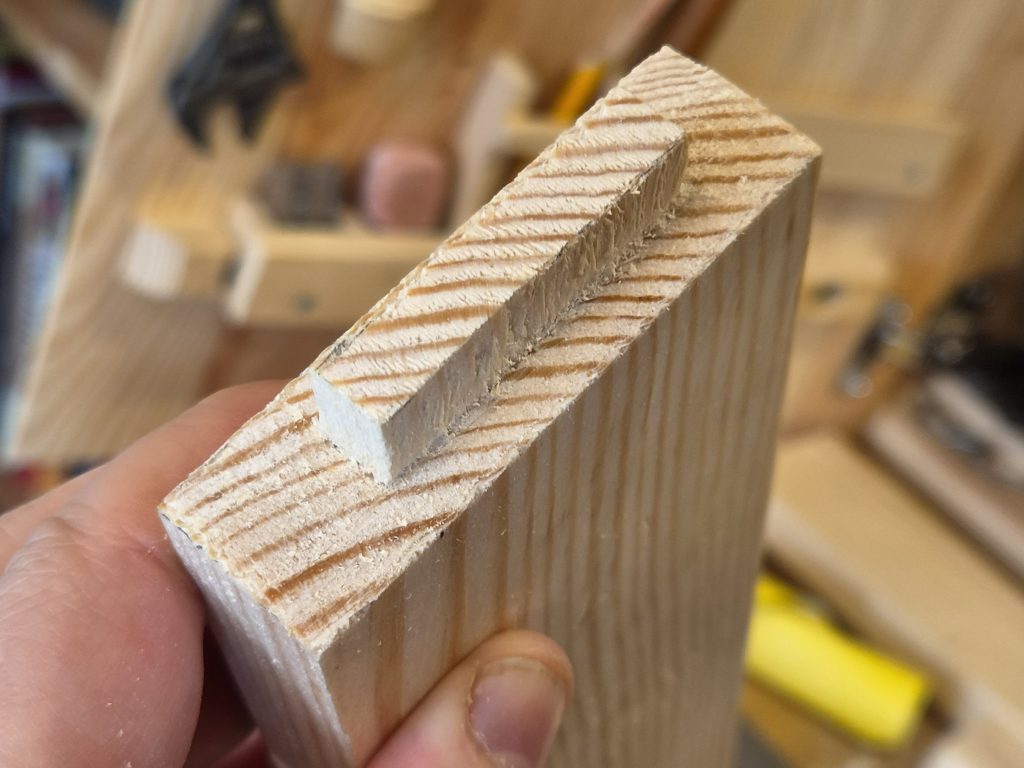
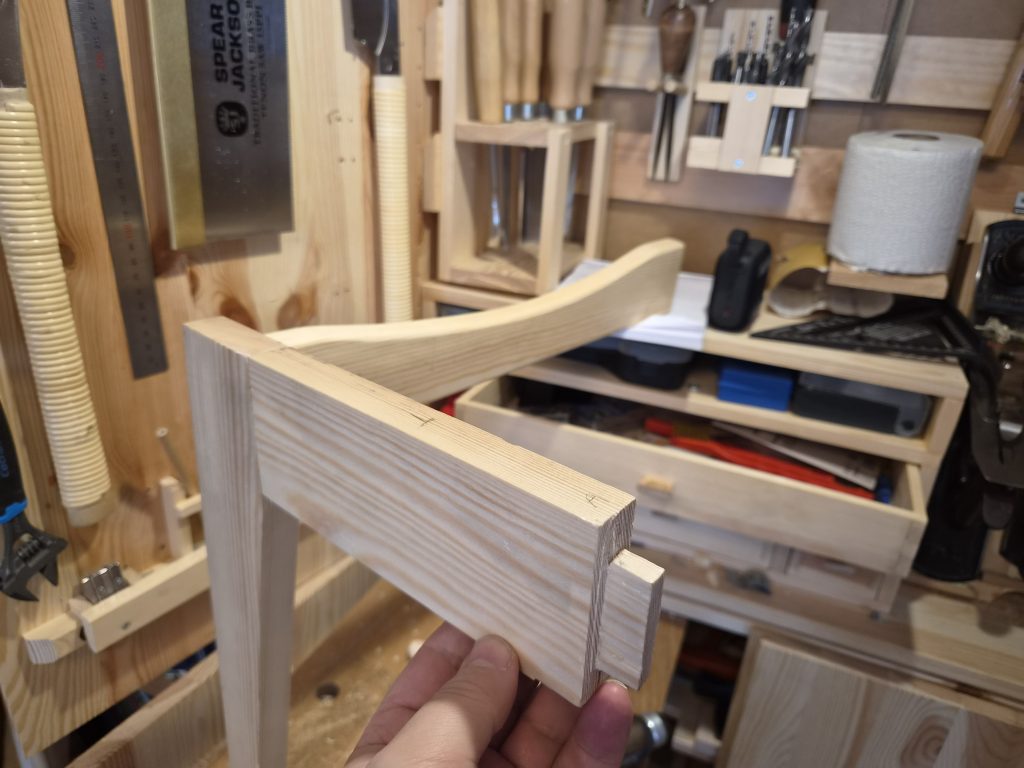
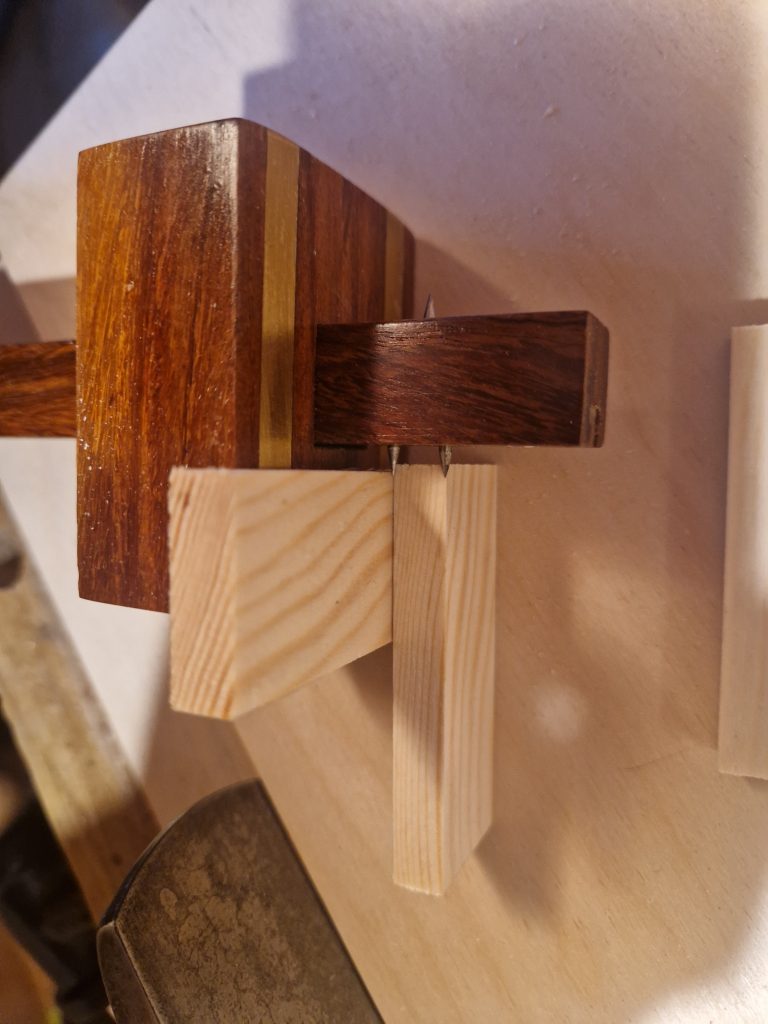
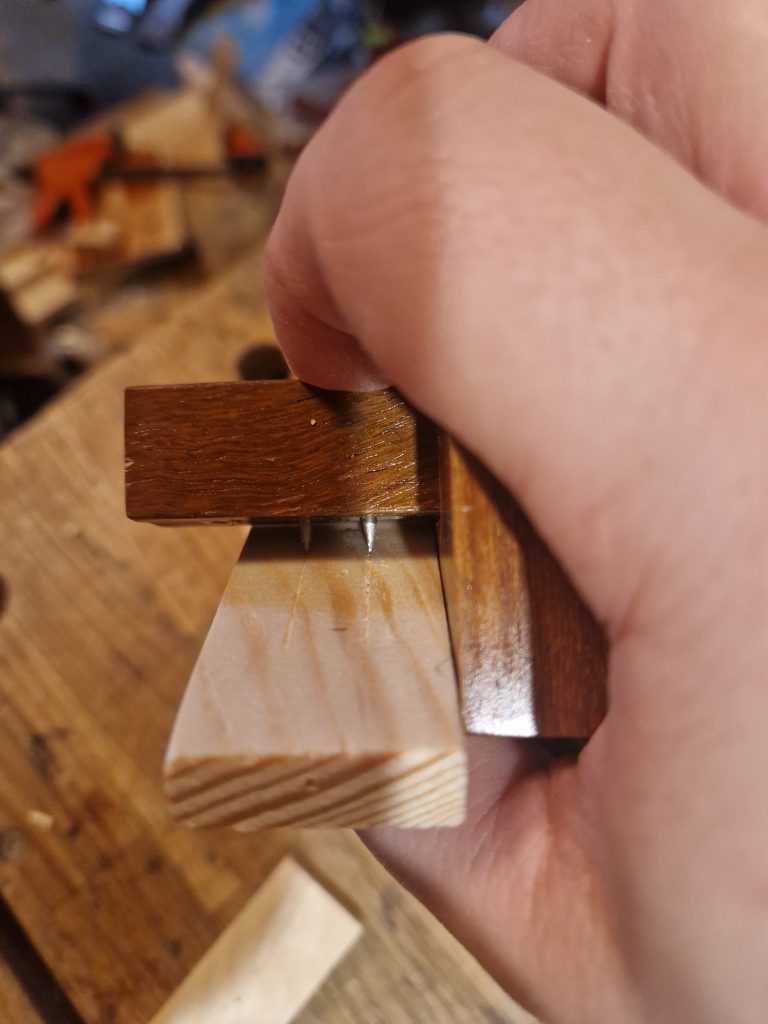
I made mortise and tenon joints for all joints. As I had to make 8 in totalt, I got better during the process. I used a marking gaugue to mark both the mortises and tenons.
My grandfather’s old router plane came on handy to adjust the tenons. He died in 1985, but my father had some of his tools which I could use.
I was watching a lot of Paul Sellers videos to learn a trick or two making the mortises and tenons. The first ones were good enough, but I got a lot better on the last ones.
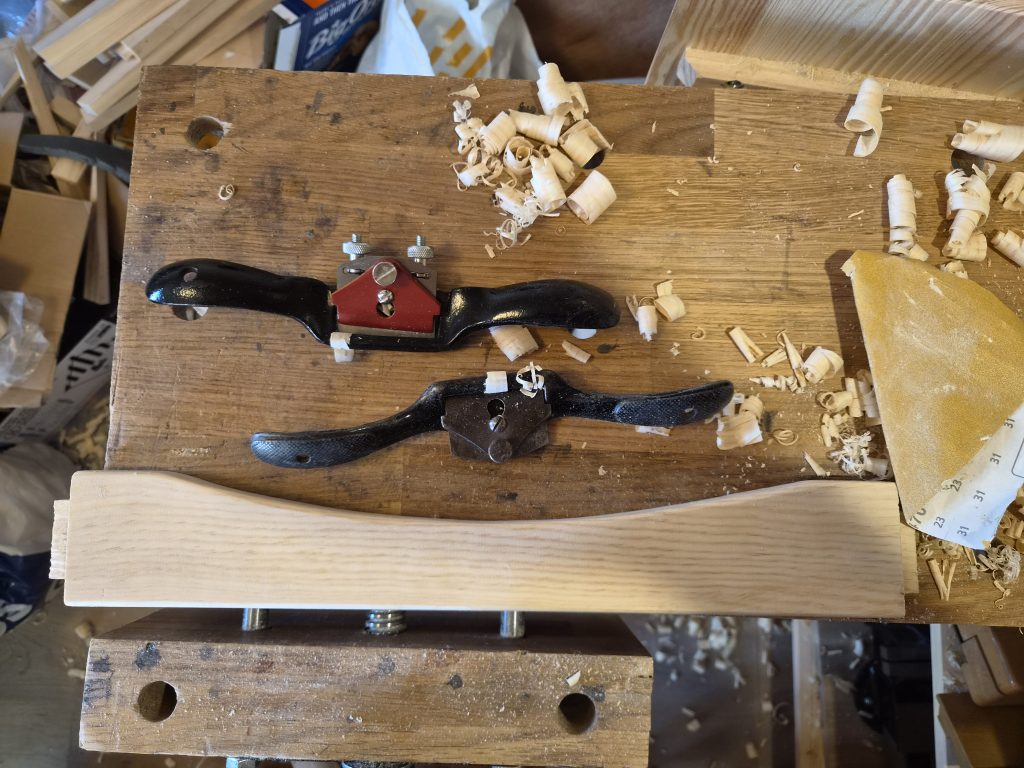
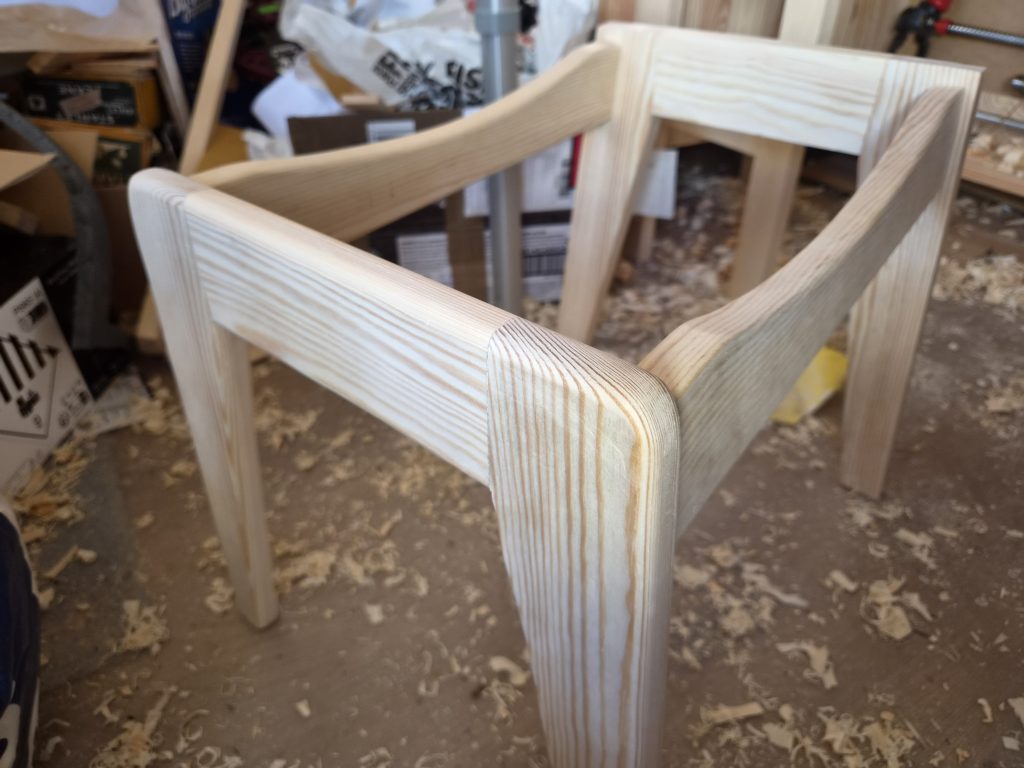
I rounded of the corners with a saw file and the edges with a Stanley 4 and spoke shaves. I used the spoke shaves to make the round profile of the long sides as well. The Stanley 151 is a new one, and it is easy to adjust, but my grandfather’s old 51 was sharper and more accurate, so I used his for the finish. It is still super sharp from his sharpening as nobody has used it since he died. I very much enjoyed including his tools in this project. I finished off with a lot of sanding from 120 up to 320 grit.
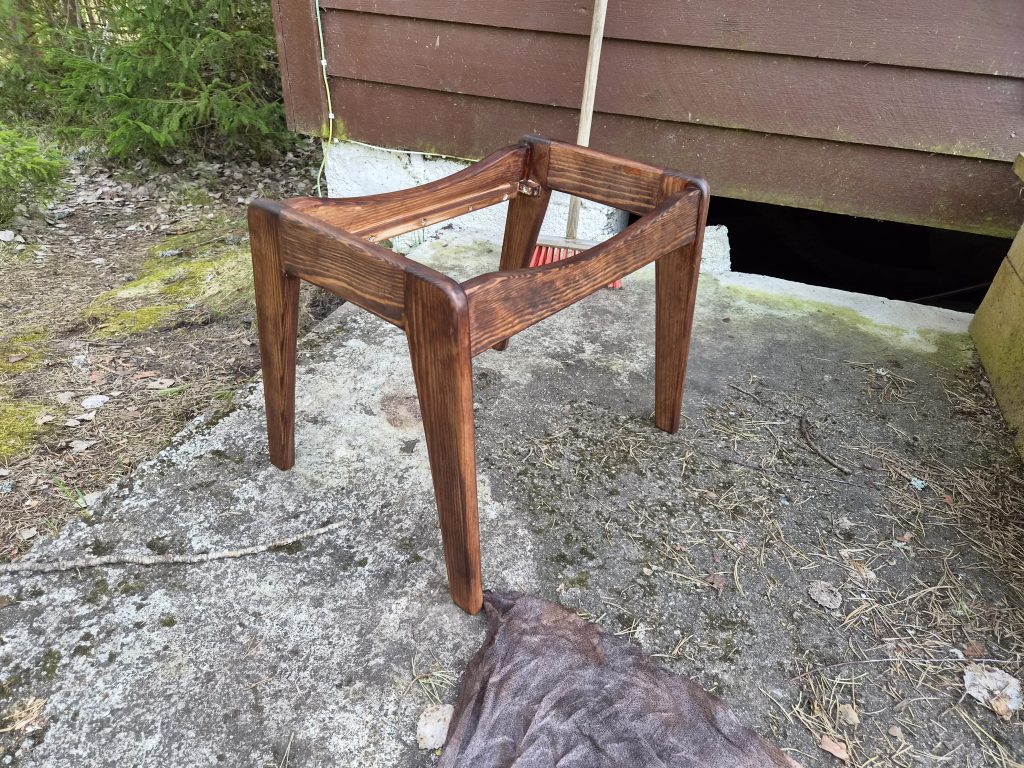
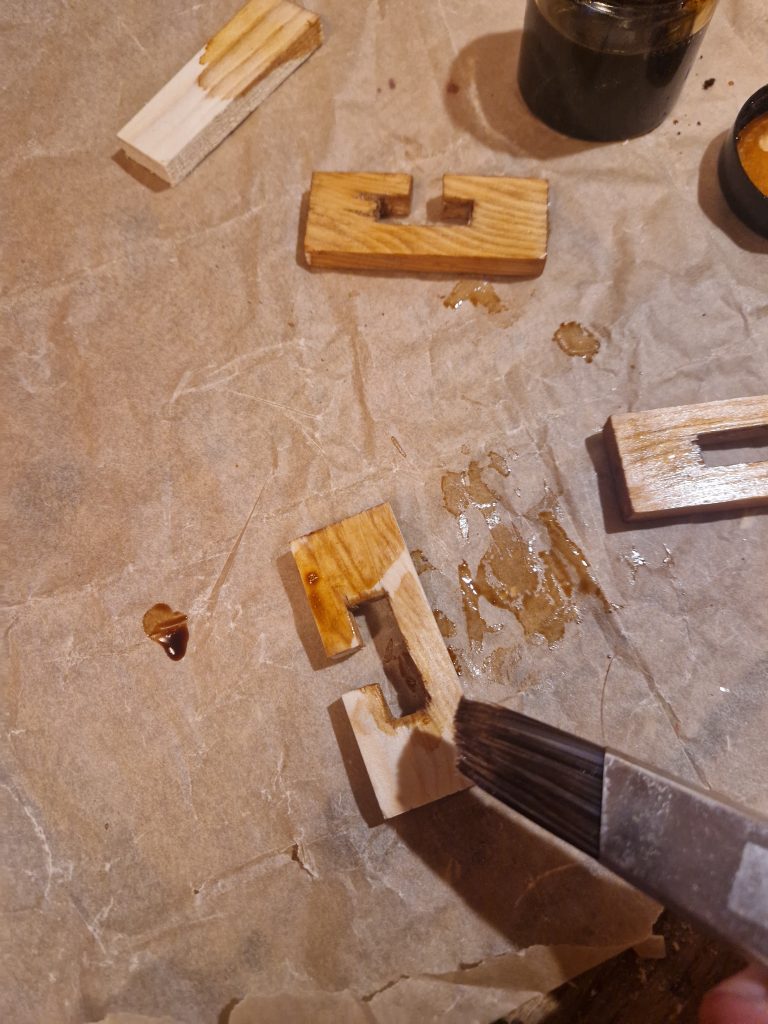
I used dark brown wood dye and water based half blank floor varnish on top of that. Three layers with 320 grit sandpaper after the first and 600 grit after the second.
Here are pictures before and after applying the wood dye:
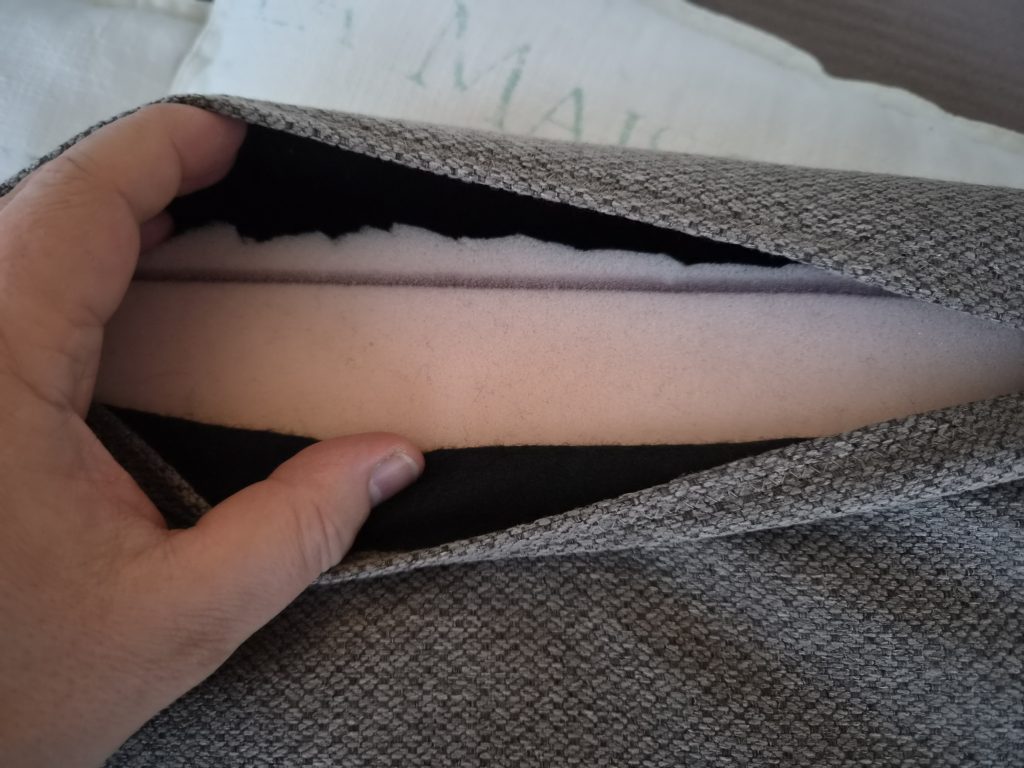
I had bought some fabric made for use on furniture, and some foam from a boat shop meant to sit on. I also added some extra padding to better hold the shape around the edges etc.
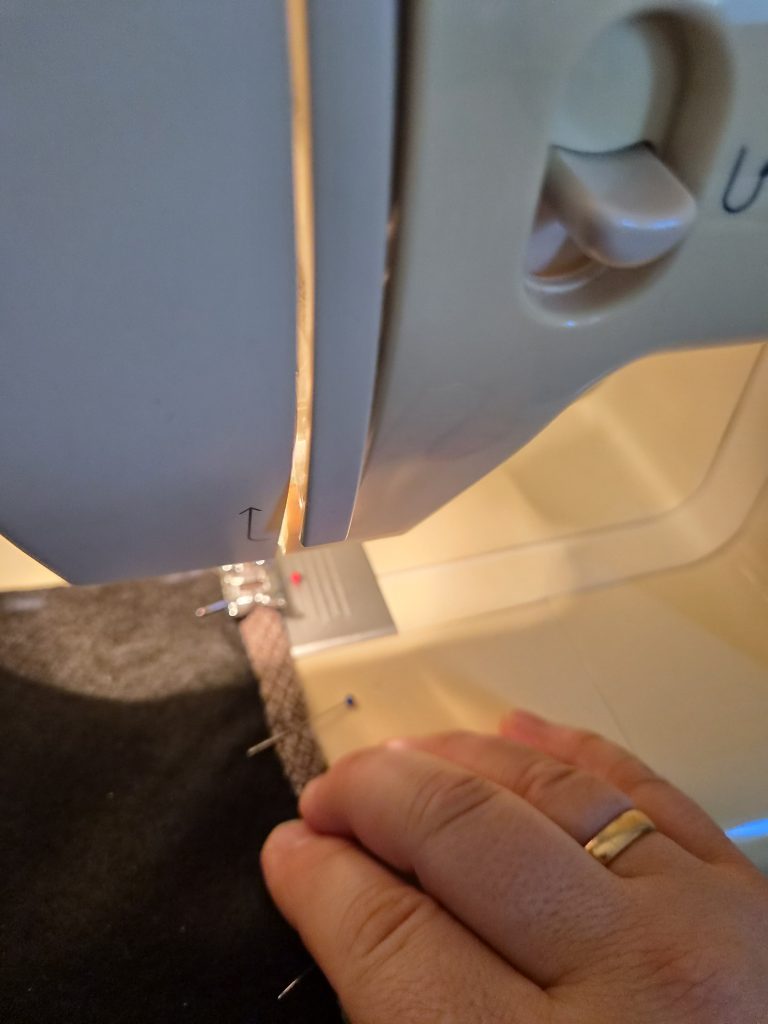
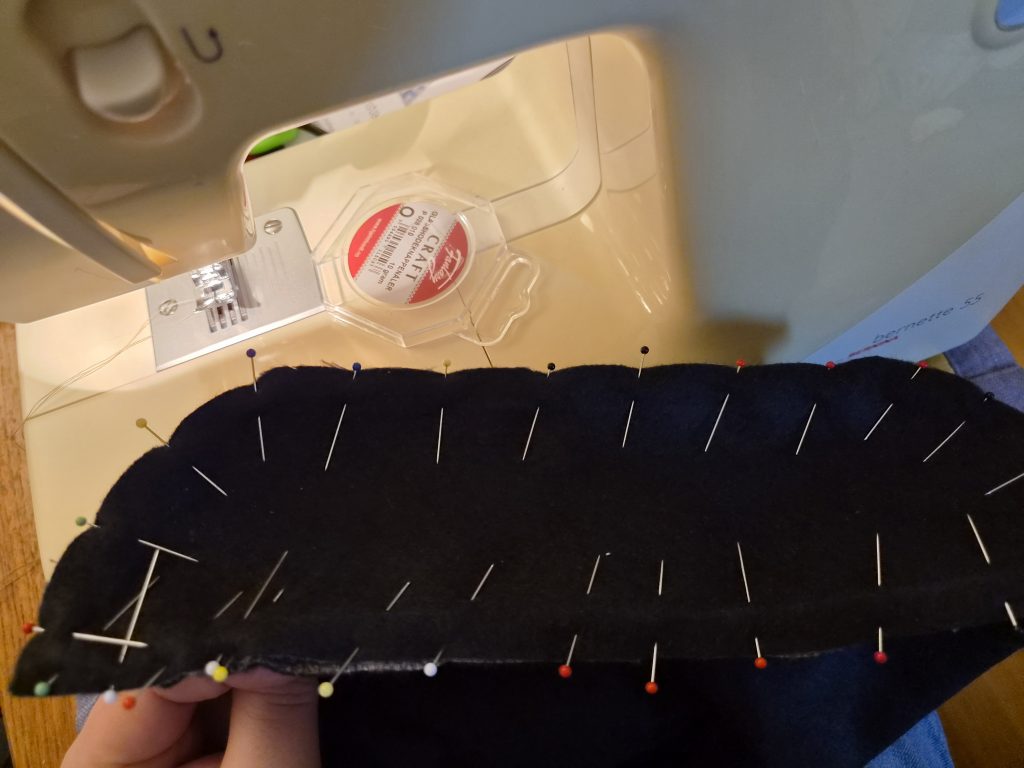
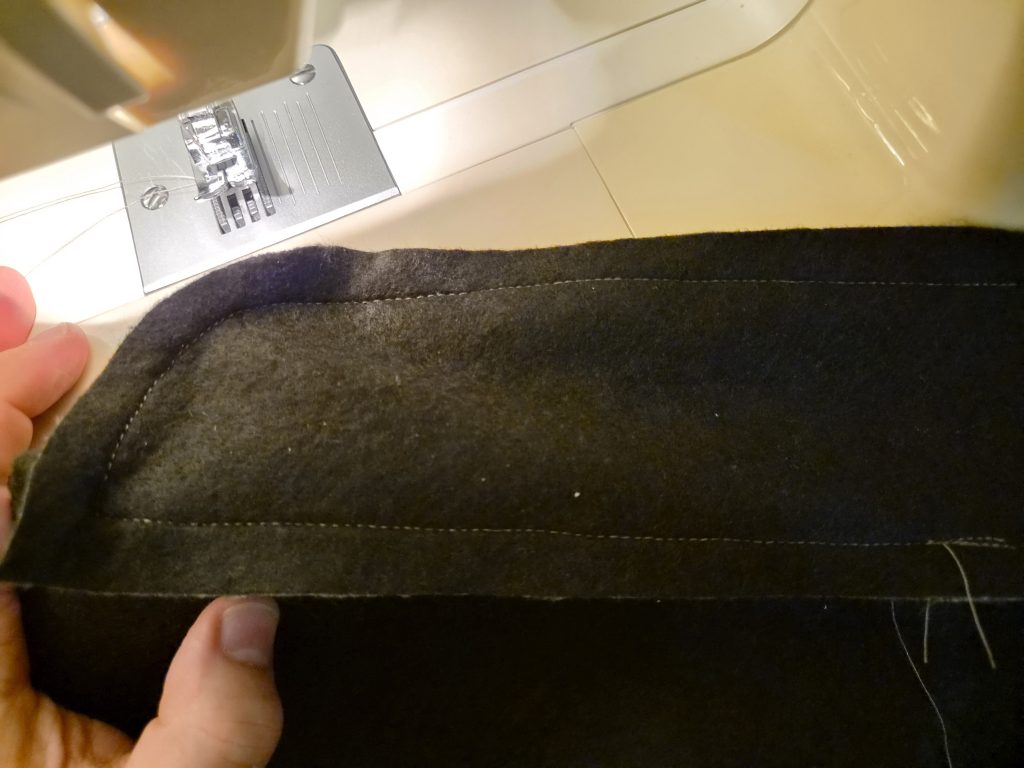
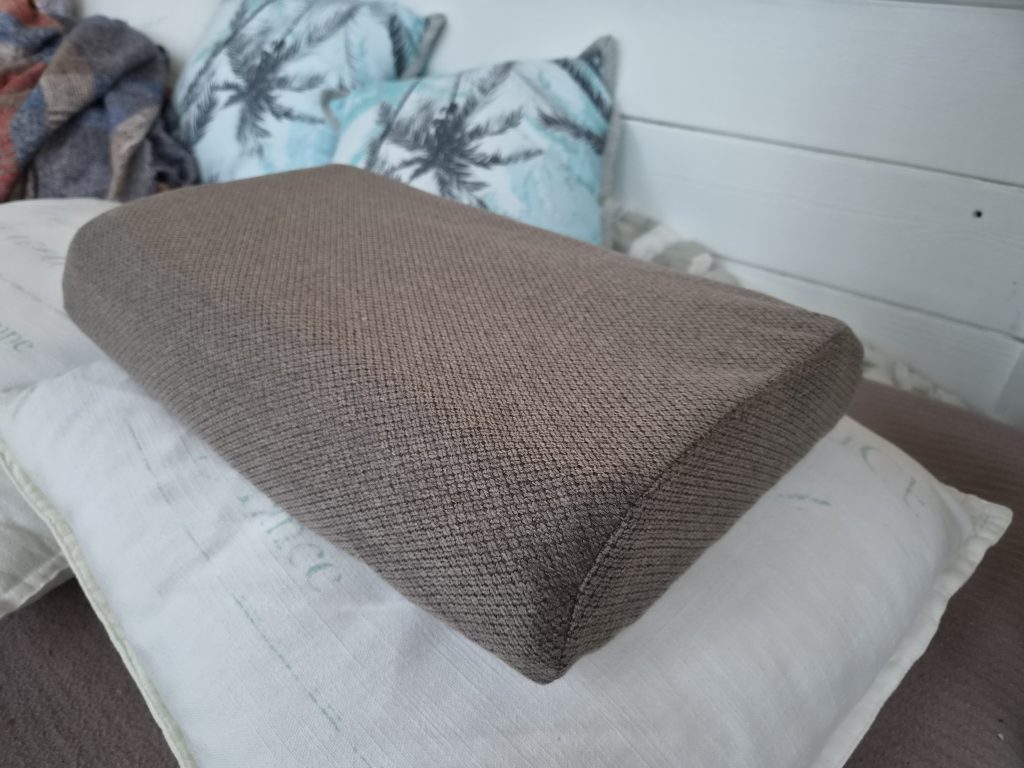
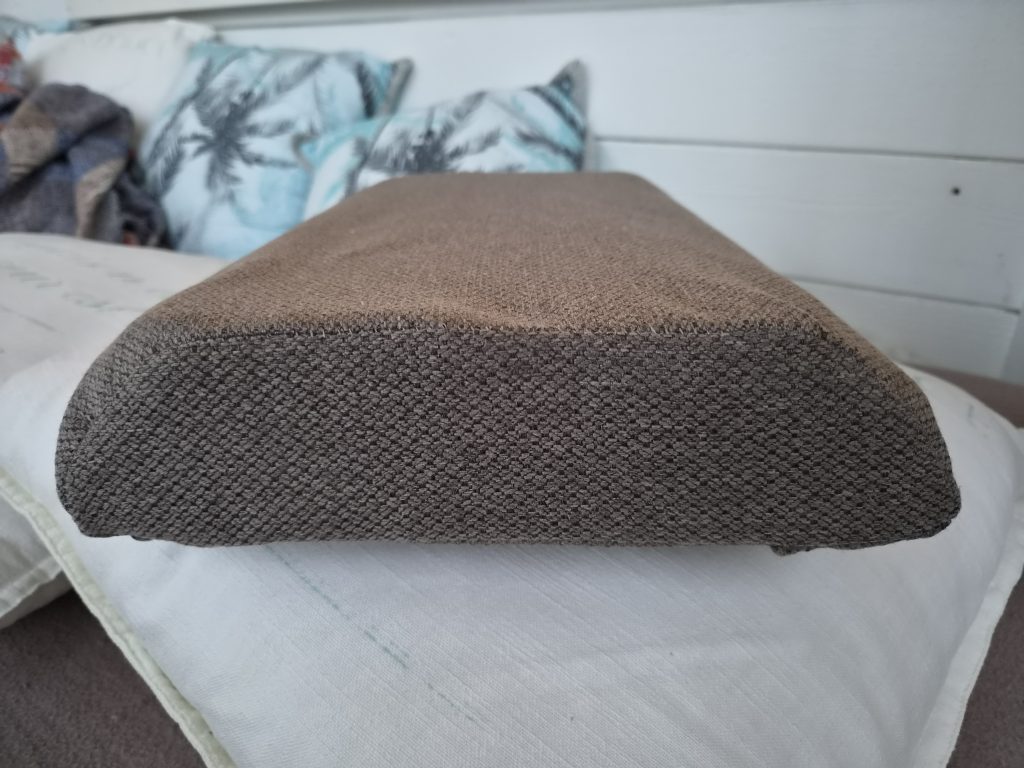
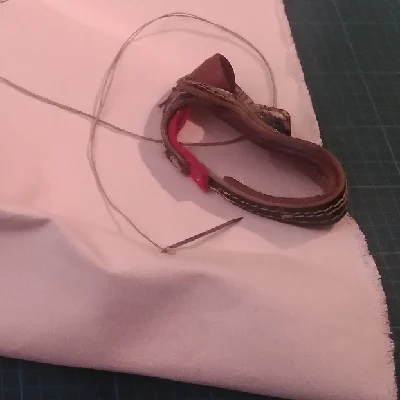
My wife’s sewing machine came on handy, and she only helped me setting it up. I did the rest myself which I am proud of as I haven’t done a lot sewing in my life. Here is the pillow without the padding as that was added later:
I am quite happy with the result as I think it fits our old recliner and as it actually was quite comfortable. Now I need to figure out what to make next…
When I took up woodworking and bought some chisels a while back, I got slightly disappointed. The chisels were OK, but not as sharp as I would have liked. I have three vintage Stanley planes. Two of them were really sharp upon arriving, but they had also become duller over time. So it was time to get into sharpening
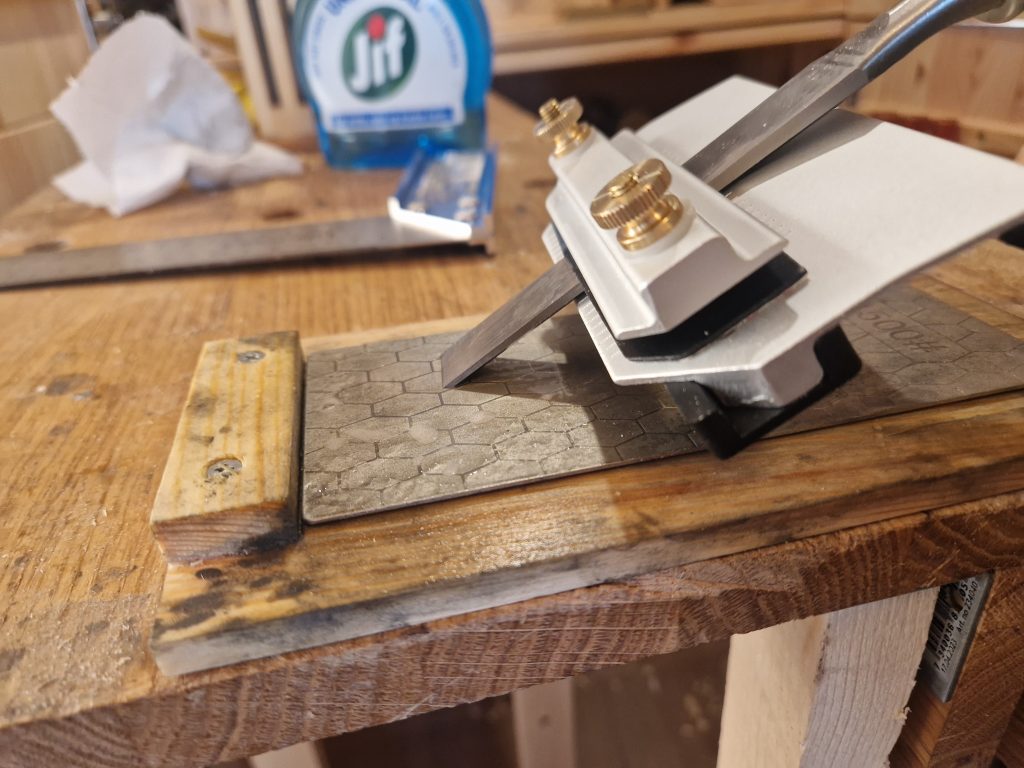
After some investigation I bought diamond plates as they were an easy start. I also bought a jig to hold chisels and plane blades.
The diamond plates are fast to set up. The five plates go from 400 grit to 2500 grit. This made my tools a lot sharper, but I ran into some problems
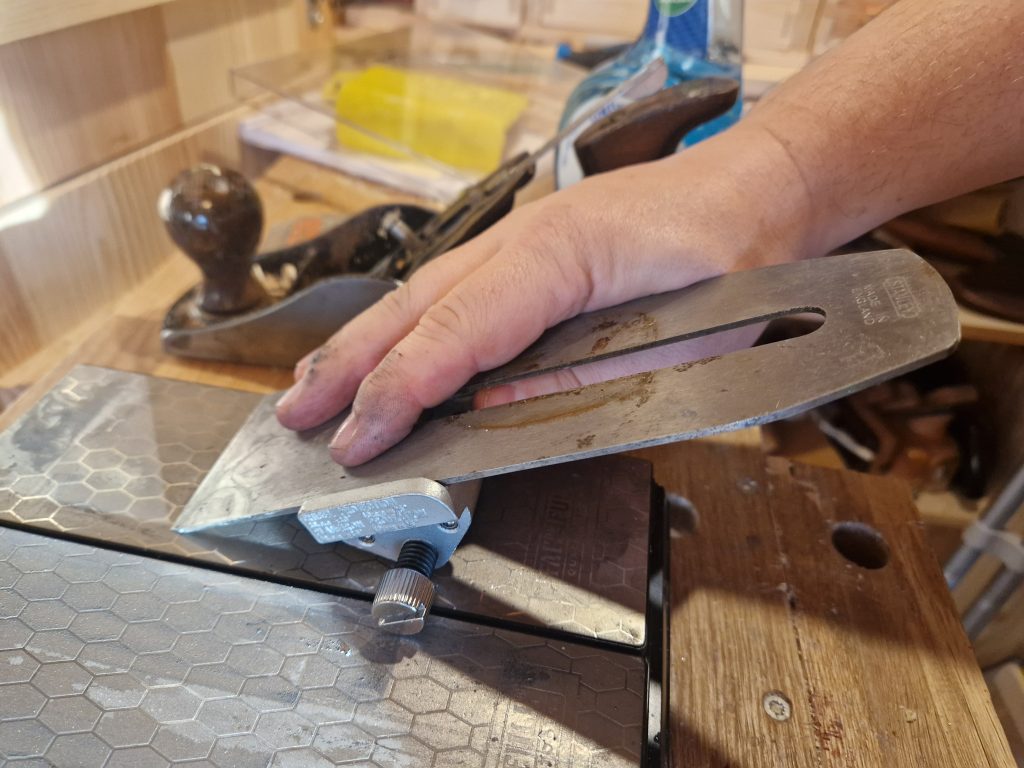
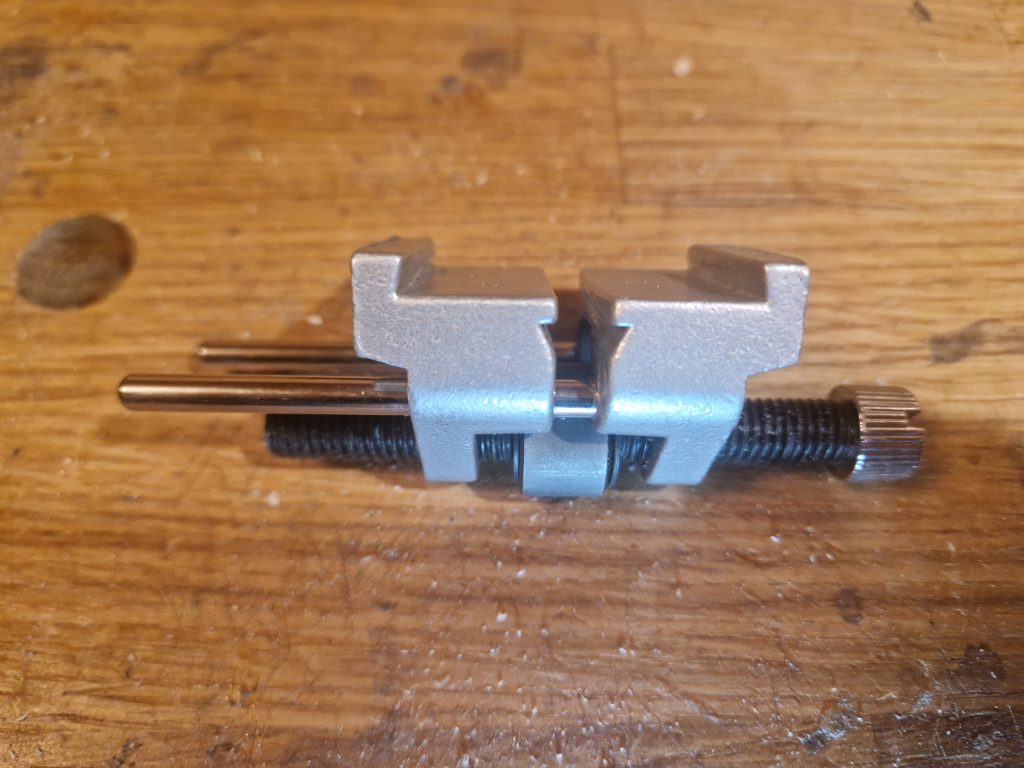
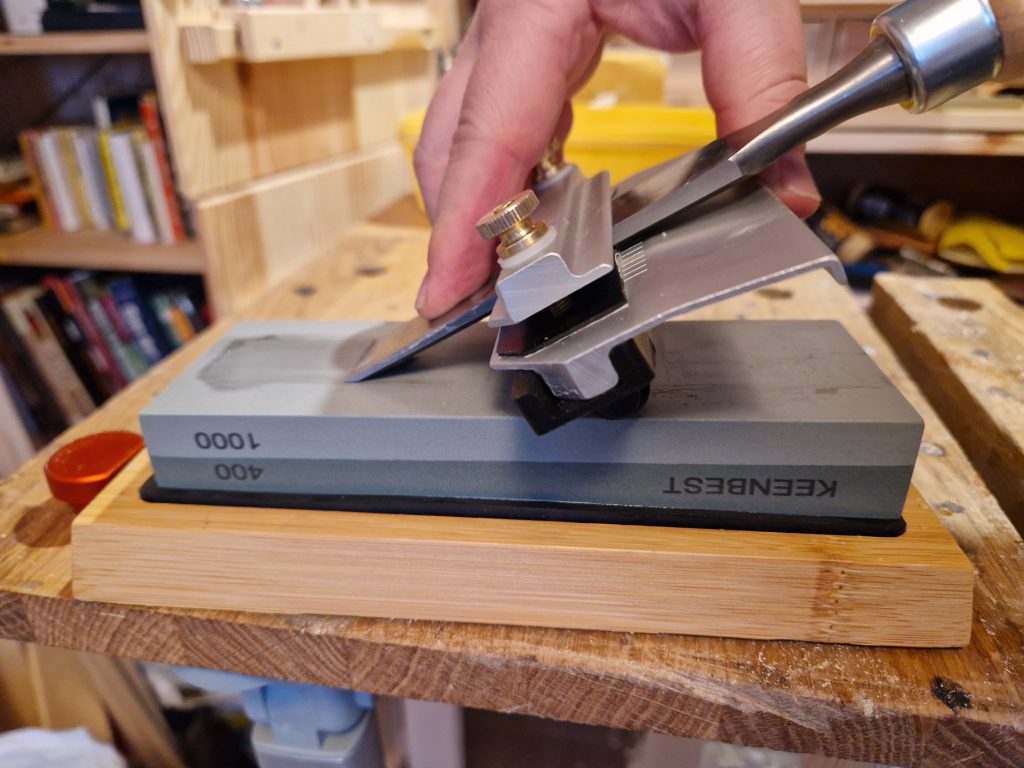
The jig was also quite cheap. You clamp on the plane blades or chisels from the side. A small wheel underneath makes it easy to roll back and forth over the diamond plates. But the wheel is too narrow, so it is easy to make an uneven pressure on the blade. In addition, it didn’t hold the blade square. I tried to adjust this many times, but the blade was always sharpened with a skew which was not OK. So therefore I bought a new, and better one from hoggjern.no (my favorite woodworking shop). This one is from Narex.
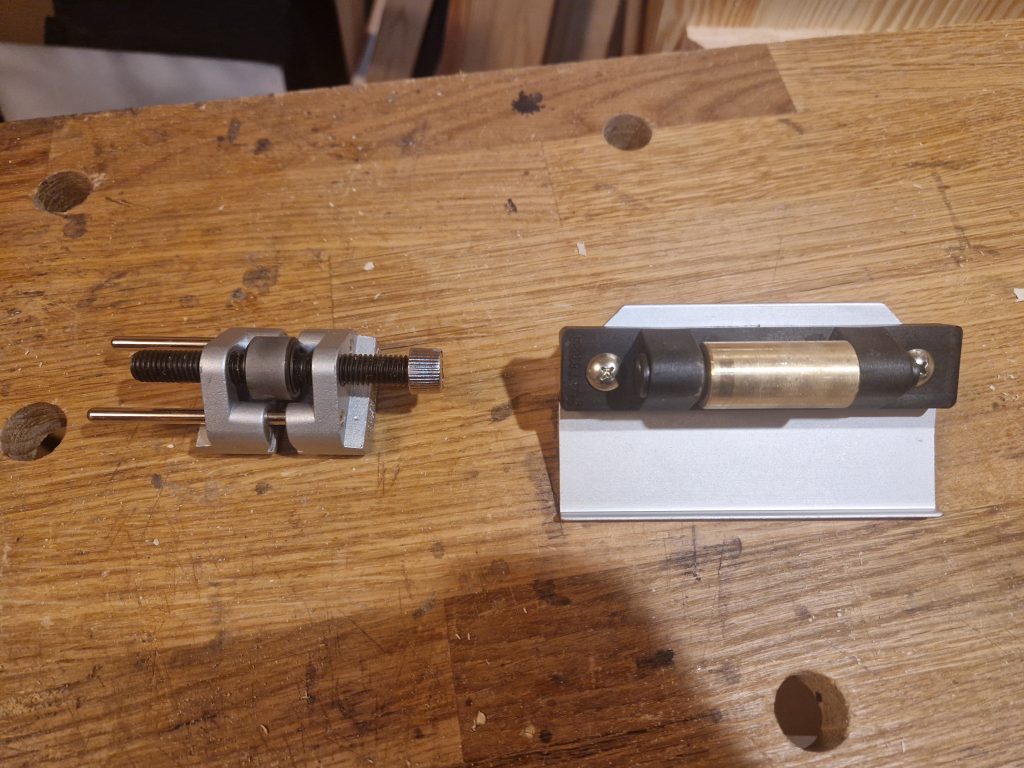
This jig is better for two reasons. The first reason is that the wheel is much wider, which makes it easier not to get more pressure to one side
It is quite a difference compared to the old one. The second reason is that it is easy to hold it square.
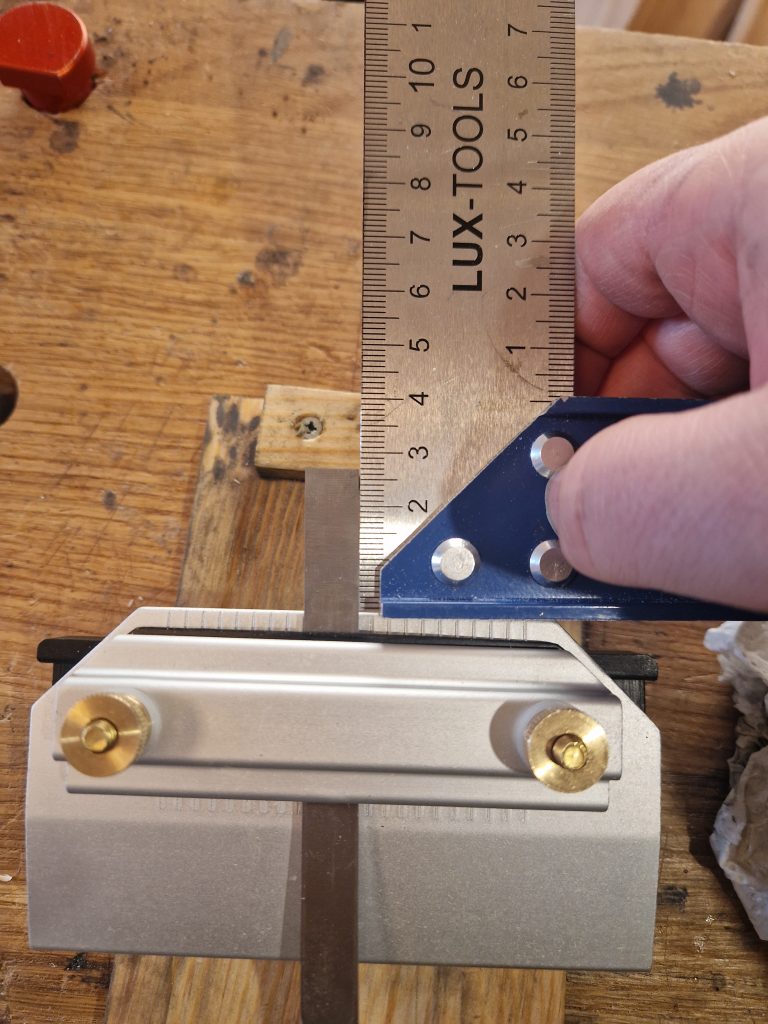
The guides makes it quite easy to adjust by sight only, but you can also check it with a square. I did, however, mess this up at first. If the two tightening screws are uneven (lower on one side), you end up sharpening more to one side. This is easy to avoid as soon as you are aware of it, though. The result was much better.
My diamond plates were cheap, and I can see signs of wear already. I therefore wanted to try another option. Instead of buying better diamond plates, I wanted to try wet stones.
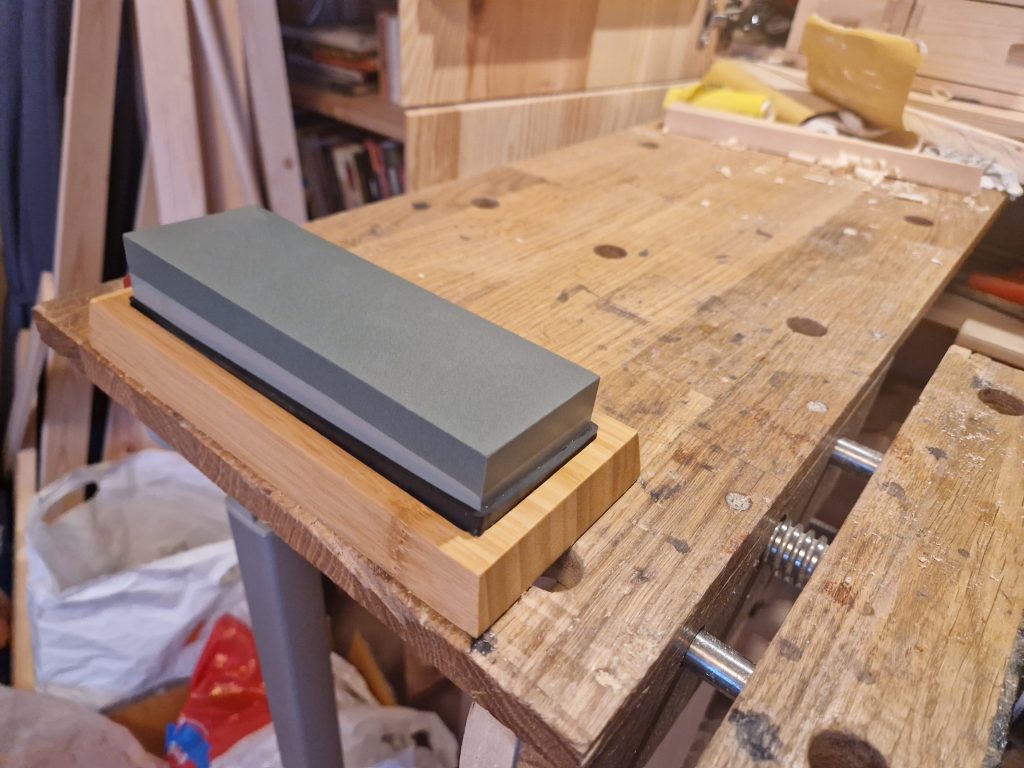
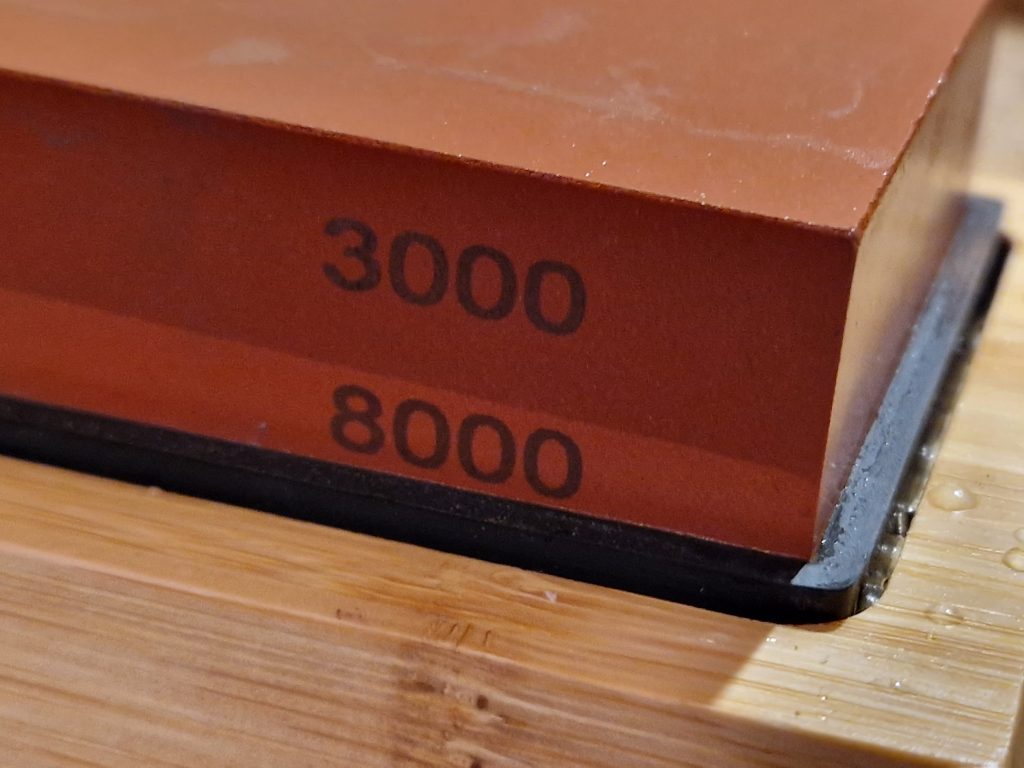
I got two stones with different grits on each side. I got 400, 1000, 3000 and 8000 grit sides.
They need to be soaked for at least 10-15 minutes before use, according to the manufacturer, but I see YouTubers mentioning hours, so they either have to be constantly in water, or you need to plan ahead. It is also easier to get water around your workbench with this, but they were easy to use.
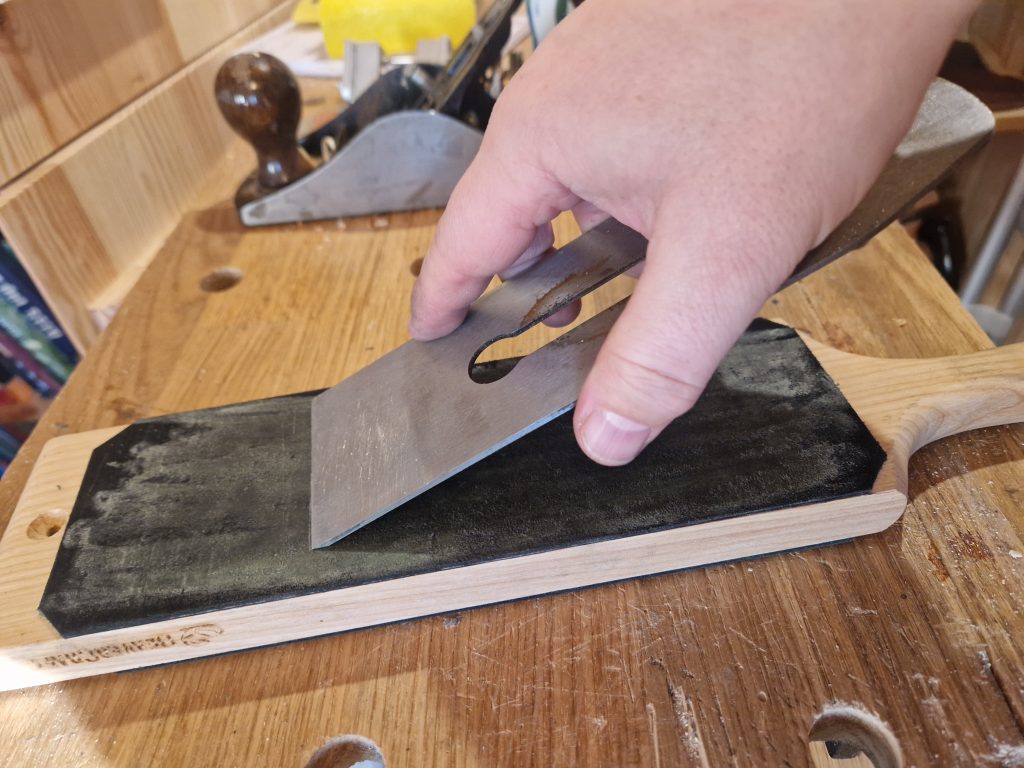
After sharpening, with diamond plates or wet stones, you should use a leather strop for the finish. I have leather on a piece of wood and use Dialux sharpening paste on it before doing the finish by hand.
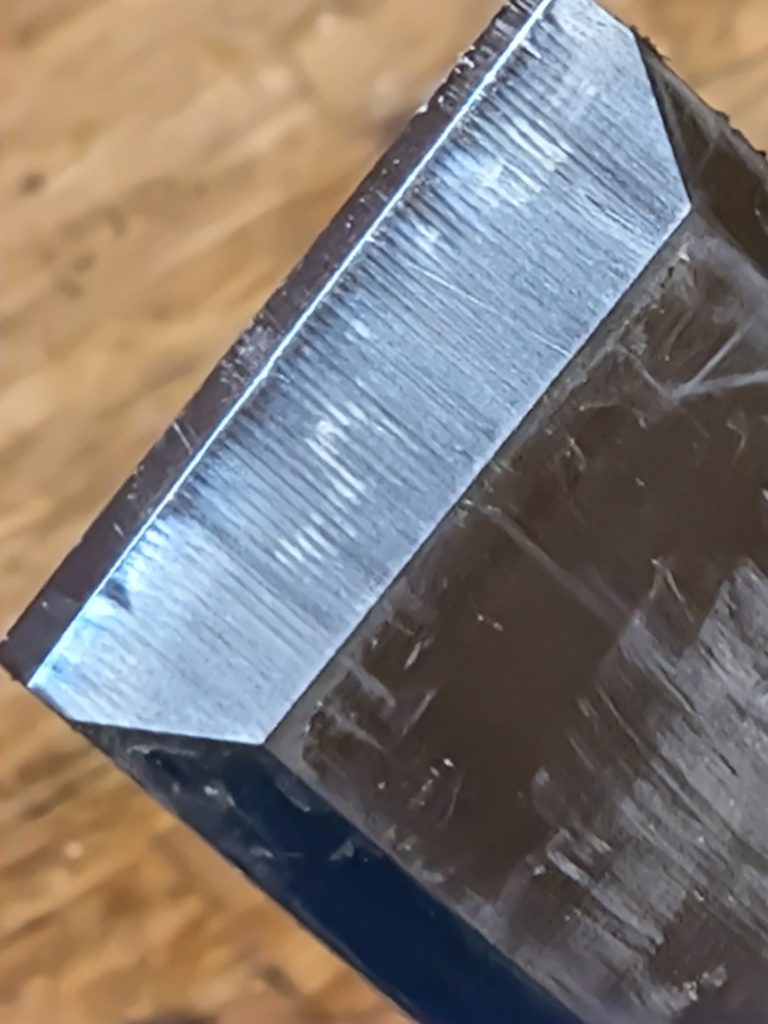
I can shave my arm with the blades after this, and the chisels are a joy to use.
(It is not cracks to the side of the edge, but wood dust after testing).
So what do I prefer, diamond plates or wet stones? It is an unfair comparison since I had cheap plates, and better stones, but if we try to look beyond that, I would say I would like to have both. The plates are instantly ready and less messy on the workbench, but if I plan ahead to sharpen I would prefer the wet stones. So I will keep both, and I might invest in better plates eventually.
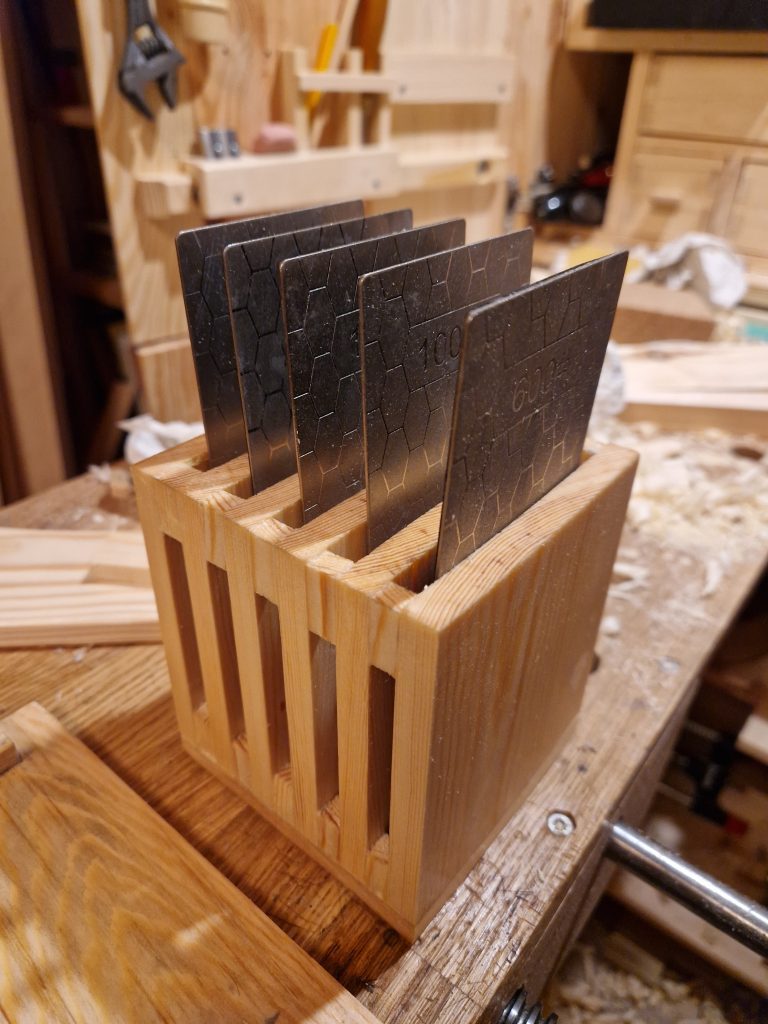
The plates can rust if not dried quickly, so I built a rack for them where I place them after a quick wipe.
The wet stones can last a very long time, but might need to be flattened from time to time. The kit I bought had a another stone to flatten the wet stones, so I should be all good.
My grandfather, who made a lot of furniture, never used dull tools, and I will try to keep my own tools sharp too!
I live in a flat in a city, and having a workshop was off the table. We also own a cabin where we spend most weekends. The cabin has an annex, and last year we had it insulated. This gave us an extra room for several things: My son plays (electrical) drums there on his old drum set, and we also work from the cabin from time to time, so an office was a nice addition. But I wanted a workshop, like I always hoped to get one day.
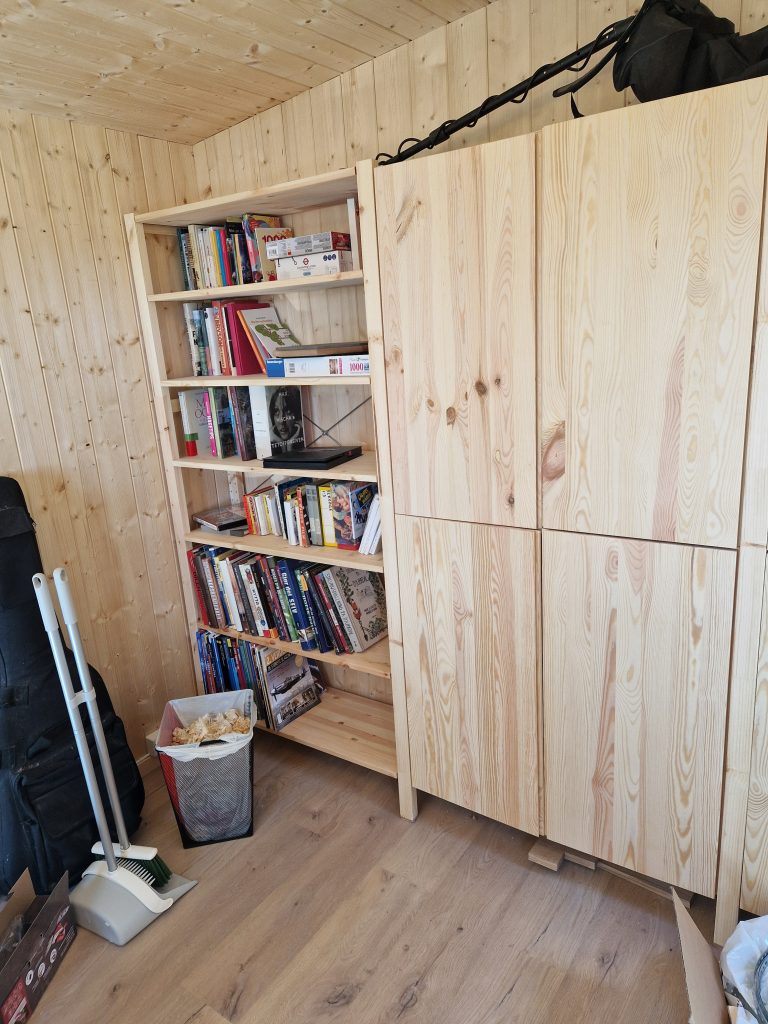
As the room is not big and was supposed to be used for several things, a full time workshop was out of question. But then I got the idea of workshop in a cabinet! In the end of the room, we have a few cabinets, and a shelf. All from IKEA.
OK. Easy enough to store the tools in a cabinet, but what about a workbench? Of course I would wish I had a big, heavy and sturdy workbench. But I don’t, and there is no room for it. So what kind of a workbench could I have stored in a cabinet?
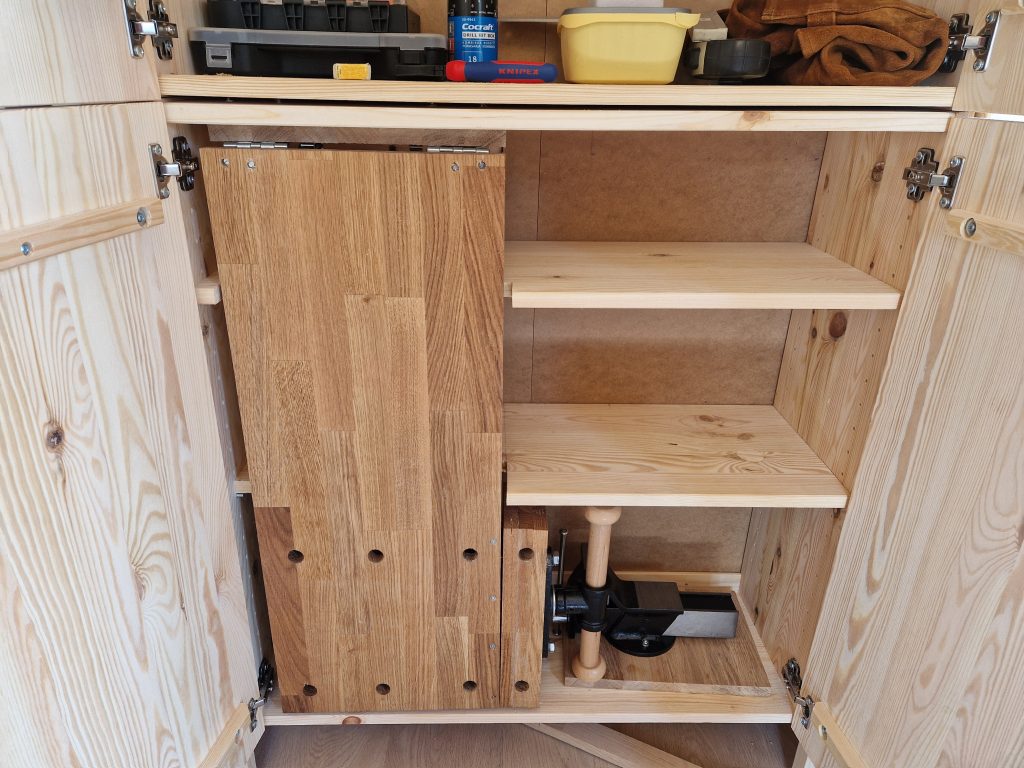
After a lot of thinking, I designed a foldable workbench in the lower cabinet that would be enough for smaller work:
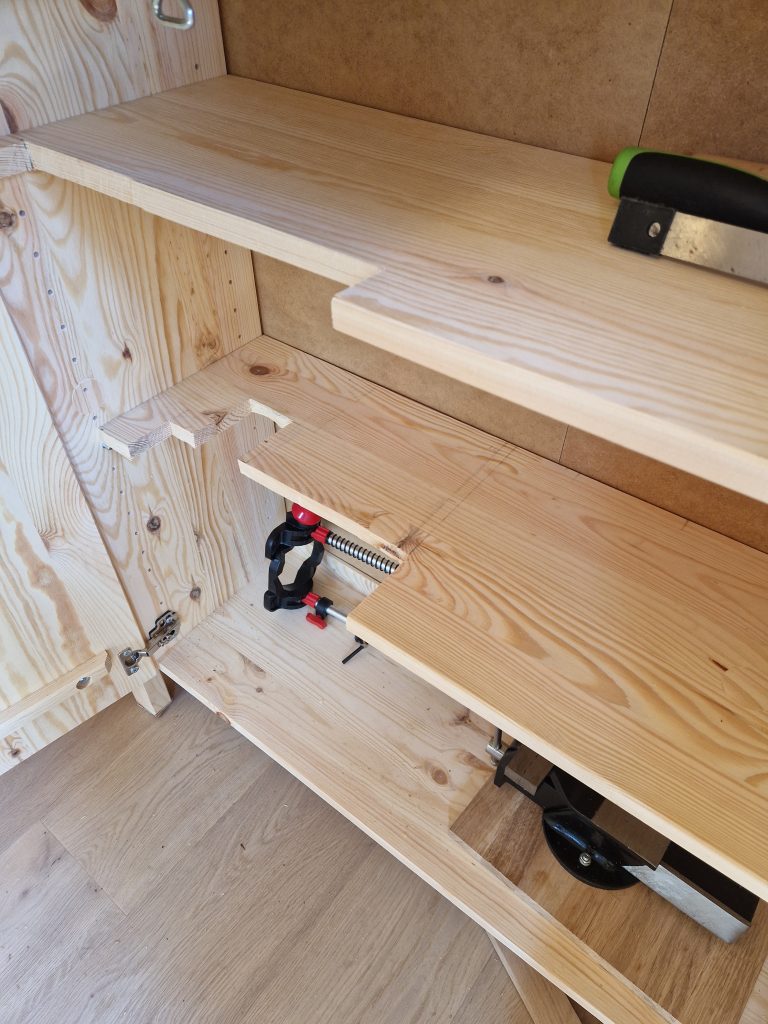
The profile of the bench was cut into the shelves
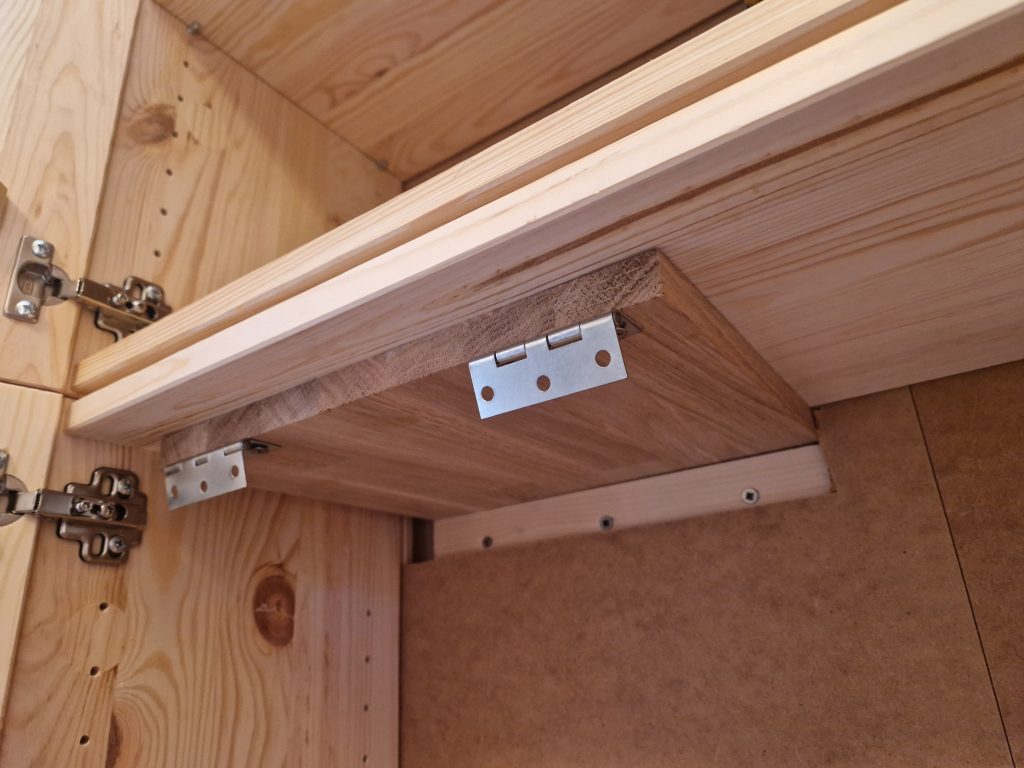
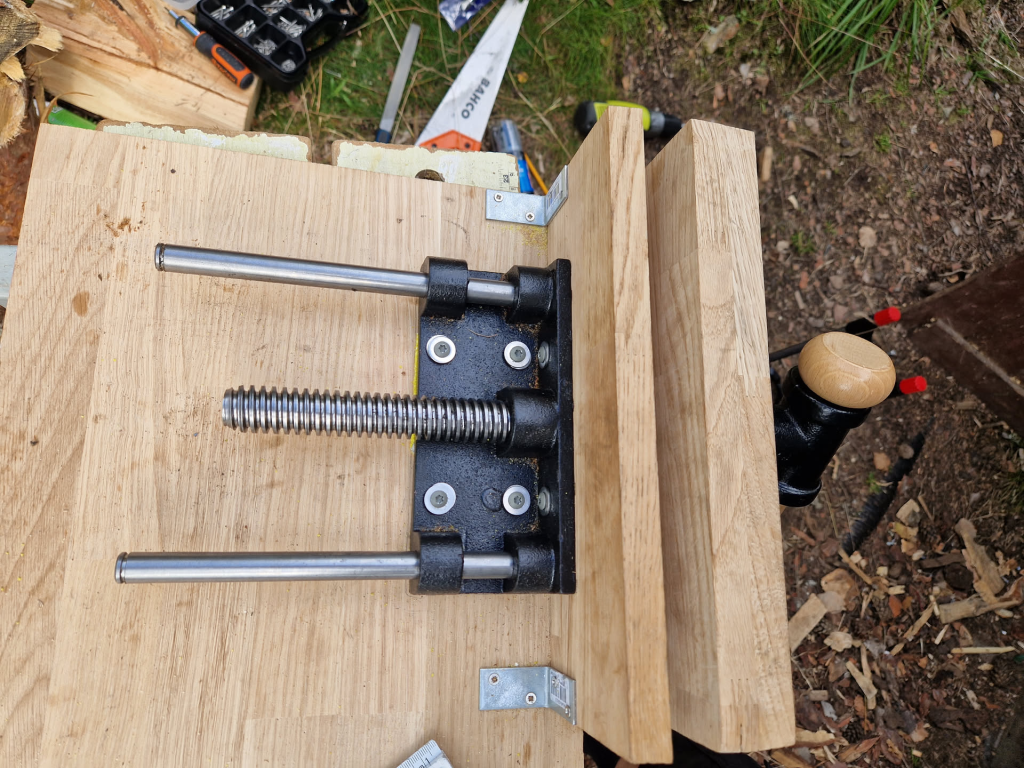
The plate is made of oak, and the hinges is screwed into another oak plate going through a hole in the cabinet onto the wall behind it, so it really can take some force onto the wall.
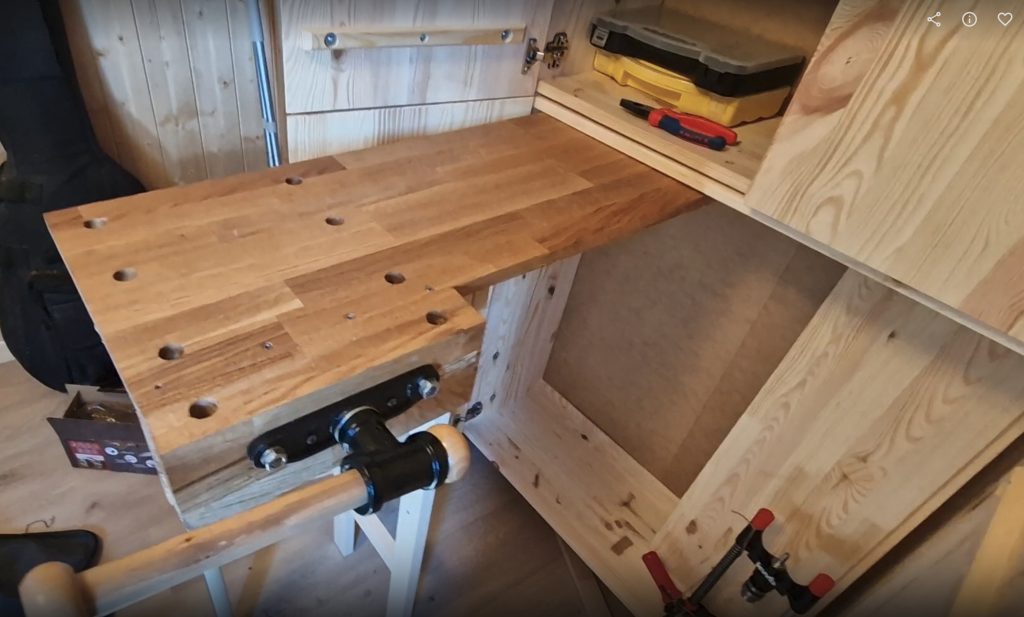
To use the workbench I need to do the following:
Swing up the workbench to a horizontal position
Fold down a leg to hold the plate.
One leg is not enough, so then I place another set of legs under the plate to take more weight. Sometimes I add a fourth one right behind the vice if I hammer on chisels there.
Then I use two box tensioners next to the hinges to make sure that the workbench isn’t wobbling in the hinges too much
Voila! It all takes less than 10 seconds to set up, and although I could wish I had a bigger workbench and a more sturdy one, this has actually enabled me to do a lot of smaller work!
The vice is from Sjöbergs.
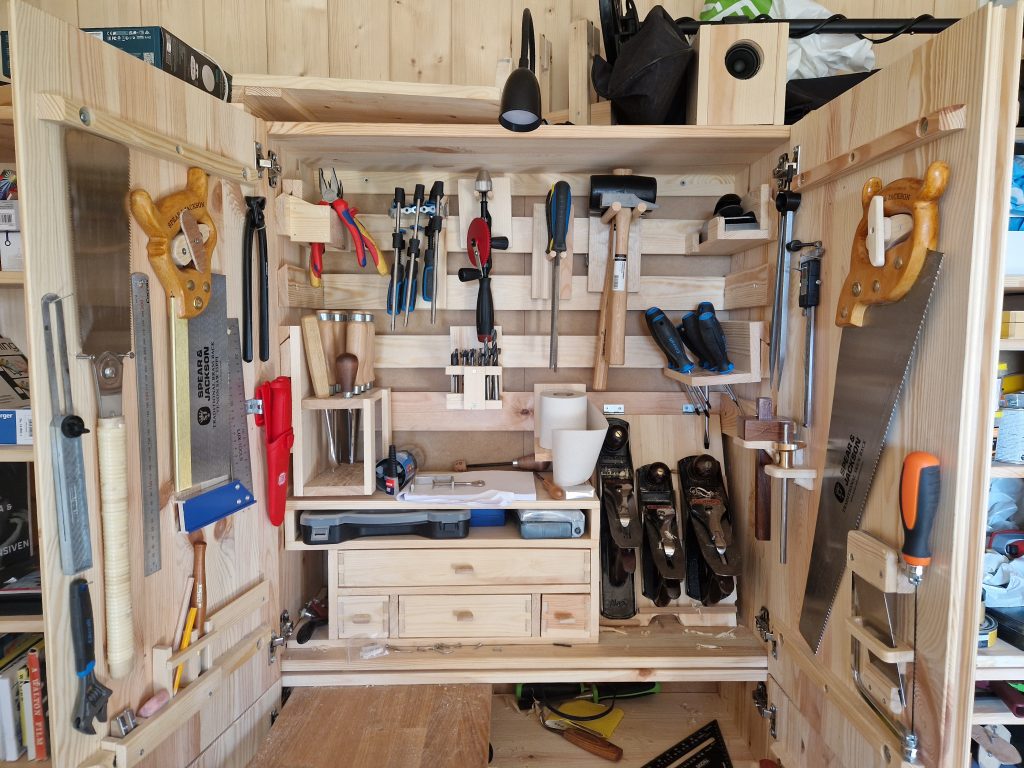
So what about the tools? Some are stored on the remaining shelves in the workbench cabinet, but the cabinet above that is what stores most of the tools:
I made French cleats inside the entire cabinet, so I can rearrange it all as it suits me. A small cleat on the left side door is empty, so I can move whatever I use the most at the moment and hang it there while working.
I made a small shelf with the drawers to store smaller things in, like screws, nails, dove tail guides etc.
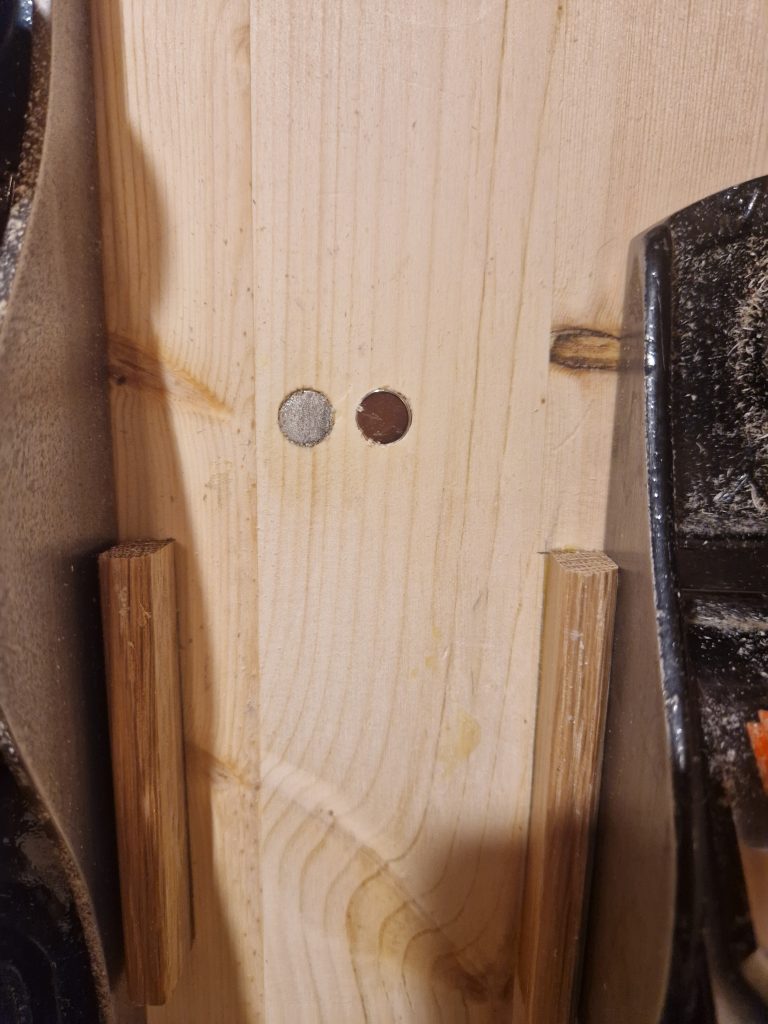
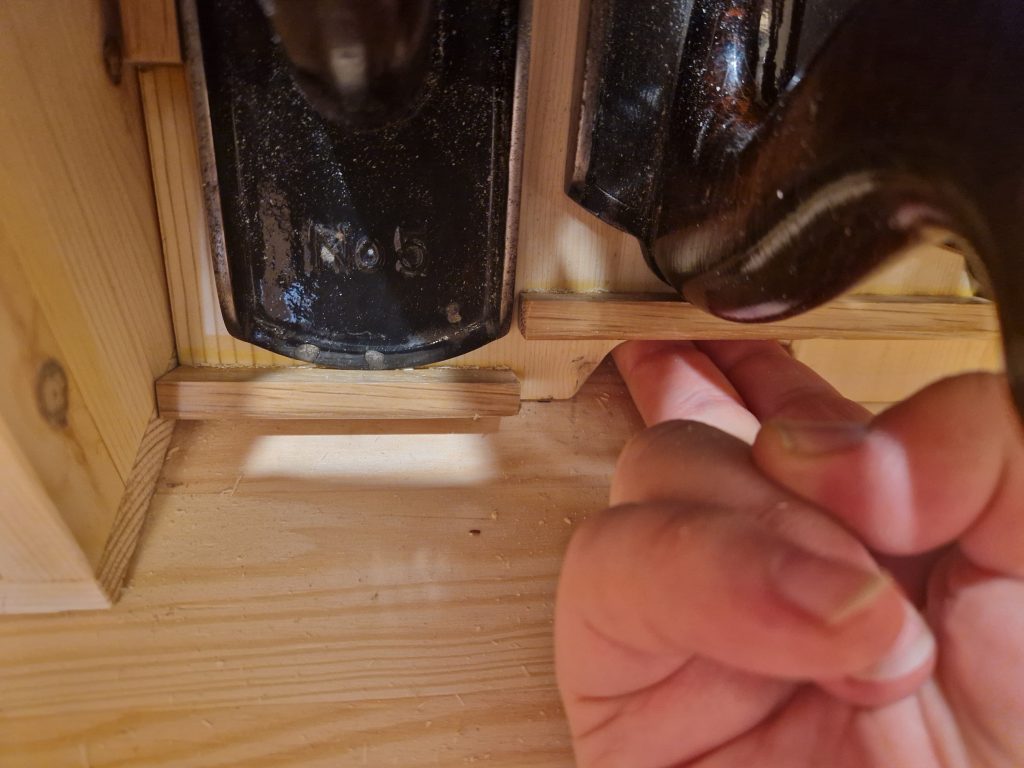
The plane rack has magnets to hold the planers, and I can grab the underside of it and swing it up as it is has hinges on the top. I store my sandpaper under the planers
So this is my little woodworking world! I know it isn’t much compared to more common workshops with larger workbenches, but it has opened up the world of woodworking to me, which makes me very happy!
What do you think? How do you manage in a small place? I would love to see other small space workshop solutions!
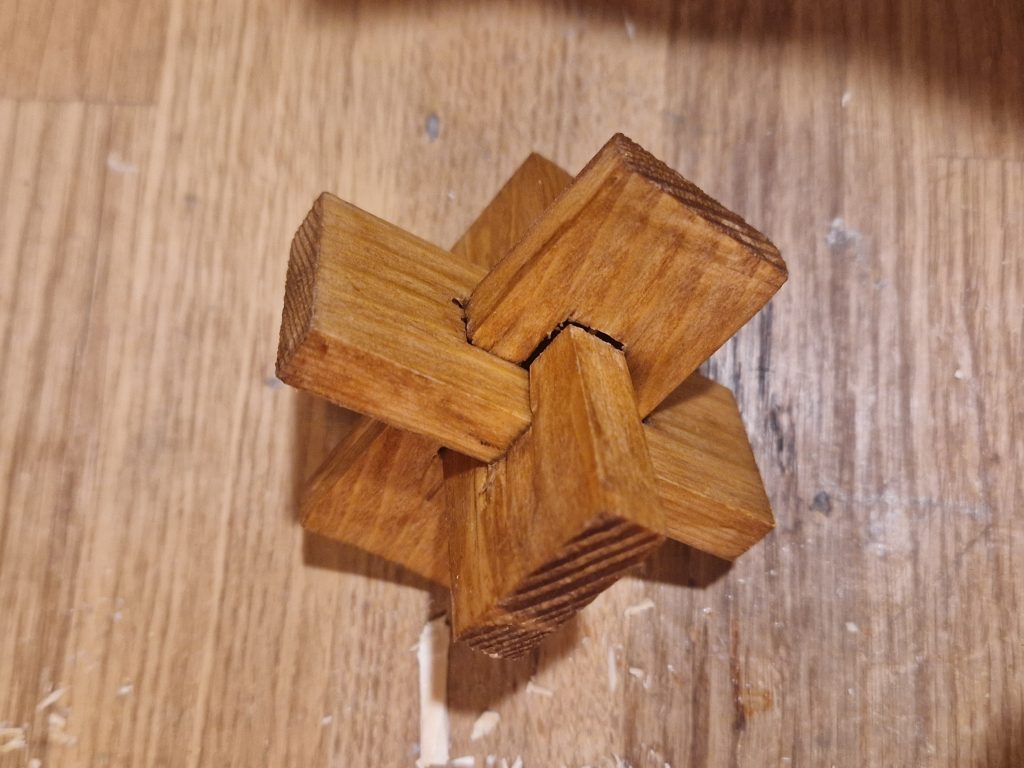
Both my grandfathers made this puzzle and other wood puzzles in their time. My mom call them “trasbokk” in Norwegian (something like “a difficult thing”). As I am still quite inexperienced to woodworking, I thought it might be a fun project to make one myself.
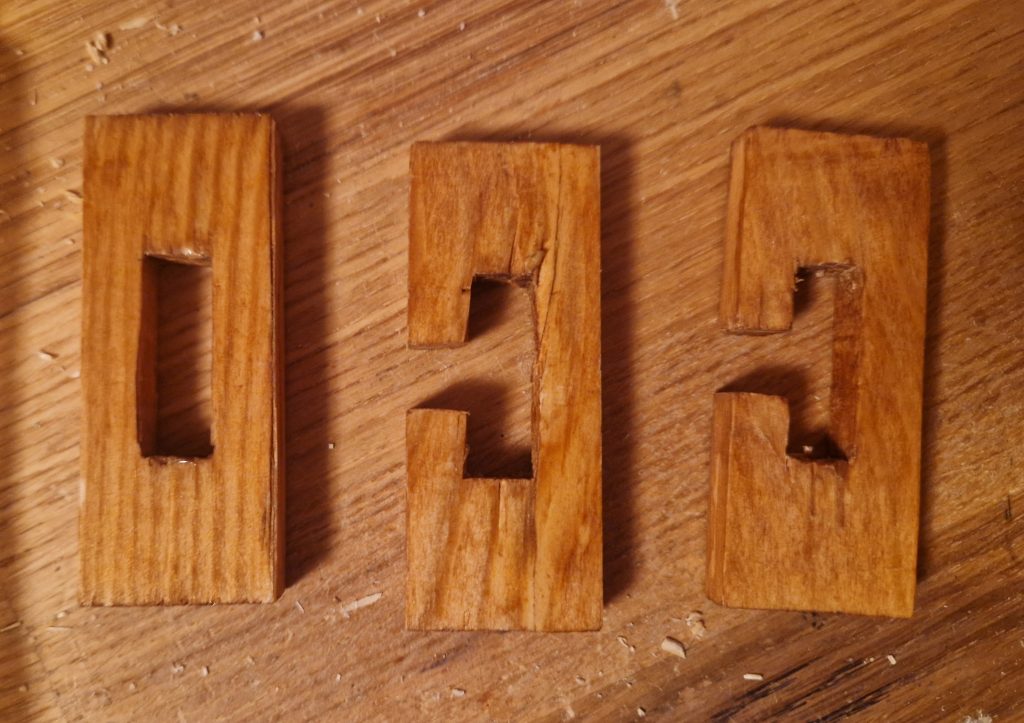
It is made by three pieces where two of them have the same shape
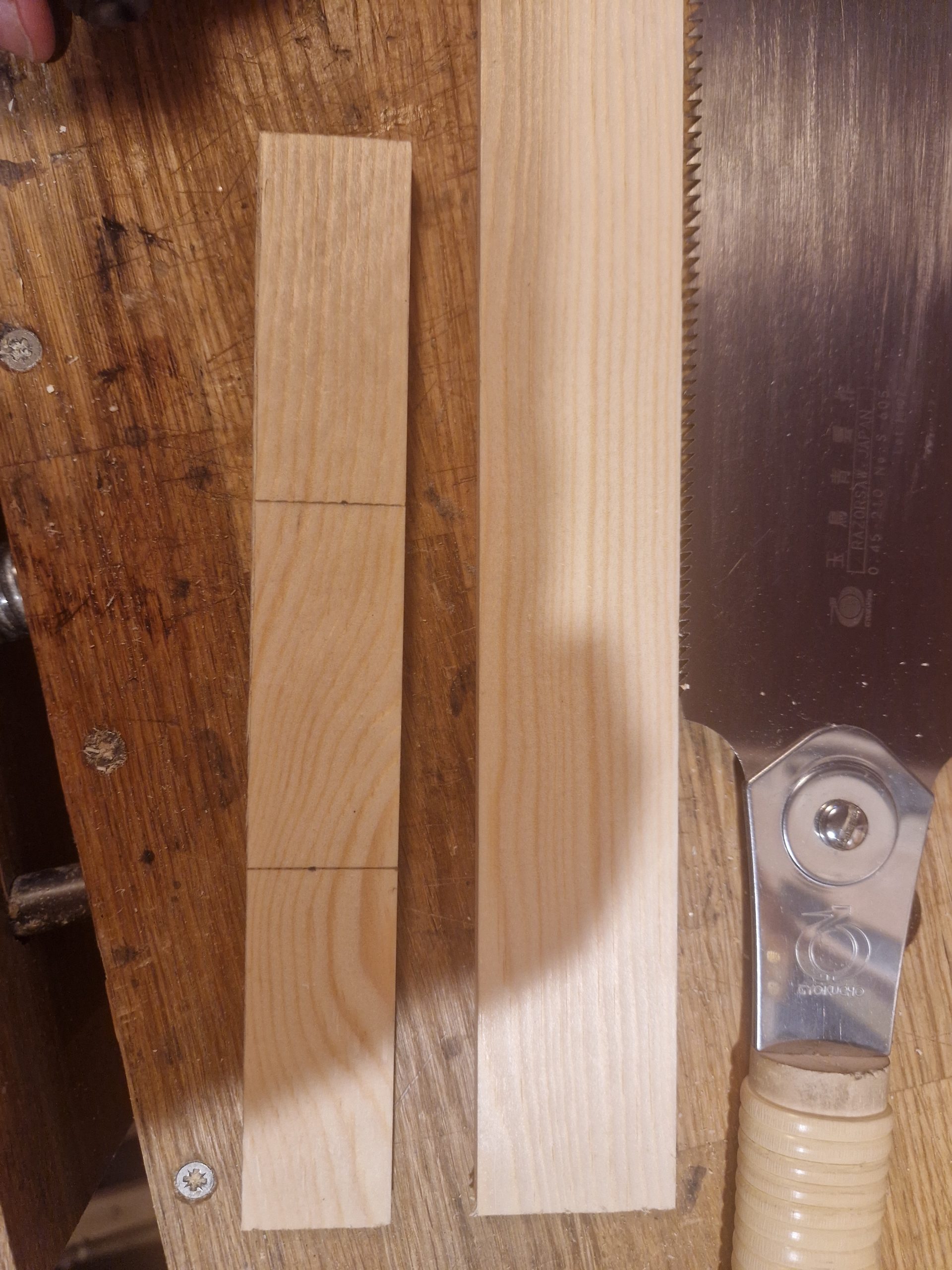
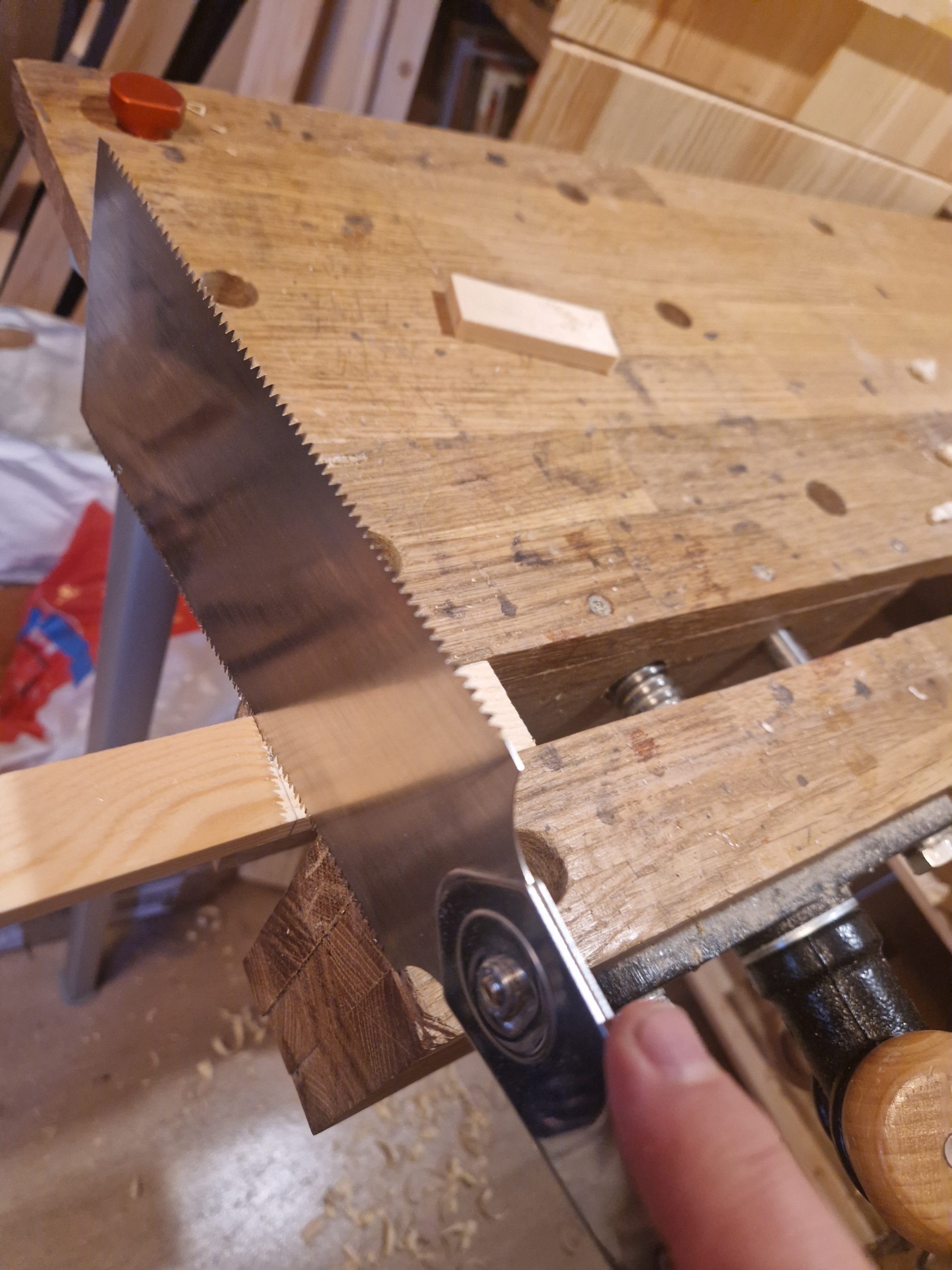
The width has to be three times the thickness. I used my wooden scrub plane, and then my regular plane to get the right width (faster than sawing it, before cutting them to the right length. The shooting board is made by Adriena Preda, and it is excellent!
With a double marking gauge, I got the markings right before chiseling out the middle.
I made a few mistakes with my chisels. It didn’t help that the material was spruce either, as it is quite unforgiving and easily makes marks. But spruce was what I had.
The last thing was to saw out the middle of two of them, before giving it a coating of colored shellac.
It is not perfect, but it was very fun to make with a little time to spare the last days of my Christmas vacation.
2025 has been a lot for most of us. The world isn’t going in the right direction, with democracy being on the retreat all over the world, and the effects of global warming becoming more and more evident. There are a lot I can’t control, but I can do something about where I store my data and spend my digital time.
Tech wise, 2025 has for me been about becoming less dependent on big tech and its tech oligarchs, improving privacy and get more control of my own data. In short: Self host or use SAAS on European grounds as the US is going down the drains.
I will start with an overview of all my new services, and continue with writing a bit on my thoughts on them and why there were chosen.
Type of service
Hosting
Comment
Mail
Proton
Moved from Fastmail to Proton.
Passwords
Proton
Moved from LastPass
VPN
Proton
Moved from ExpressVPN
TOTP 2FA
Proton
Moved from Google Authenticator
Calendar
Proton
Moved from Google
Audiobooks
Audiobookshelf (home server)
Moved from several smaller services
Podcast
PinePods (Hetzner) and AntennaPod (Android)
Moved from Pocket Casts
Pictures
Immich (PikaPods)
Moving from Google Photos (not finished)
Documents/files
Nextclound (Hetzner)
Moved from Google Drive
RSS
FreshRSS (PikaPods)
I got back to RSS in 2025
Git
Forgejo (PikaPods)
Moved from Github and Gitlab
News Archive
Wallabag (PikaPods)
I used Pocket in the old days, but got back to this type of service in 2025
Web statistics
Umami (PikaPods)
Moved from Google Analytics
In addition, I am a heavy user of Plex and Jellyfin. I mostly love Plex, but Jellyfin is open source, handles hardware accelerated transcoding better and Findroid (Android) handles subtitles for downloaded material (in contrast to the official Jellyfin app or Plex for Android). I still buy a lot of BluRay and DVDs for anything I want to be in control of for the rest of my life. They are all ripped and stored on a NAS with RAID.
Hetzner and PikaPods
I have been using Linode for years, and have been happy with them, But they are US based, and now owned by Akamai. Hetzner is German, cheap and have been great to use so far. I plan to move most of my VMs from Linode to Hetzner.
In 2025 I also discovered PikaPods who offers hosting for many open source projects. They are located in Malta (EU), and hosts their services on Hetzner. My experience so far has been very positive.
Proton
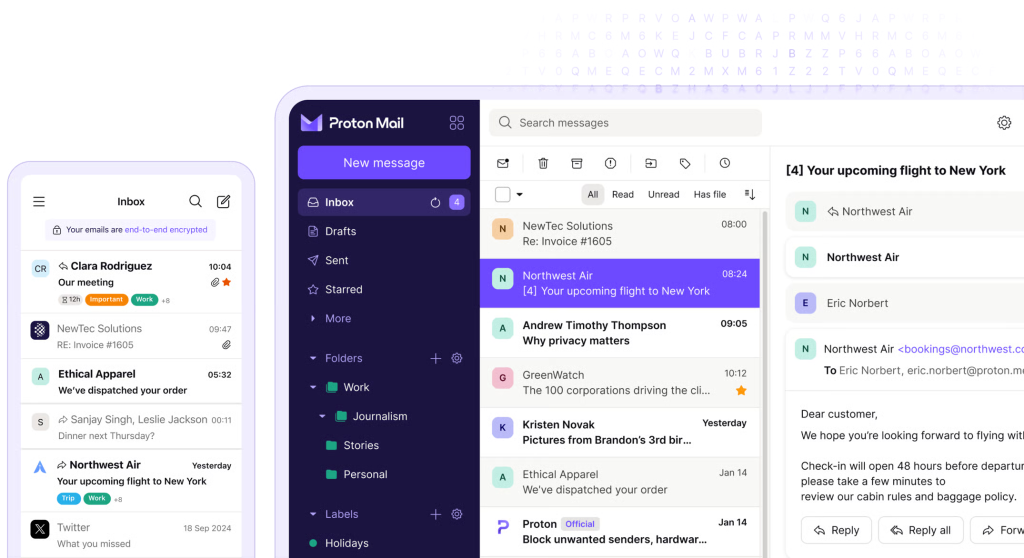
I have been using Fastmail for many years, and have been one happy bunny for all other reasons than where it is hosted. It is fast, with no hiccups, uncluttered interface and just handles mail very very well. Moving from Fastmail is not an easy one for me, but they are hosted in the US with US staff. The company is Australian, which isn’t the best privacy wise either. Keeping my most important service in the US is just not an option any more.
After much considerations I ended up with Proton Mail. They are European (in Switzerland, although they seem to be moving some services to the EU), and are extremely privacy focused. The interface is really good, better than the alternatives I looked at, and they have good apps. The down side is that I have to use their Android app as they do not offer IMAP on mobile. You can install an IMAP proxy on Windows, Mac and Linux, though.
Proton also offers a calendar, one of the other central things I looked for, which is good to have on the same service as my email, When they also offered an alternative for LastPass, Google Authenticator and ExpressVPN, it became my number one choice. Just before new year, I moved my main domain over to Proton. With a family subscription, my wife and son are also moving over soon.
Nextcloud
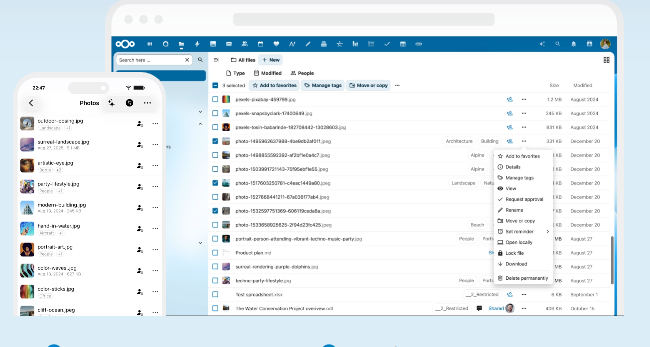
Nextcloud has been another big one for me. I have been using Google Drive quite a bit, and the integrated office tools has been great. Hosted Nextcloud is offered by multiple companies (go to Nexcloud’s home page for links to providers).
For me it was important with Collabora Office, and not all offers that with Nextcloud. But the ones that did were not the cheapest. I didn’t want to self host the main Nextcloud installation (too important for the time I have to be on top of security). I ended up with Hetzner for Nexcloud as they are dead cheap with a large disk quota. But I self host Collabora Office (CODE) on Hetzner with docker which is integrated with Nextcloud. This works great! Collabora Office Online has become really, rellay good! My only down side is that editing documents on Android hasn’t worked well for me. I hope this improves in the future as this is something I used to use a lot on Google Drive.
Audiobookshelf
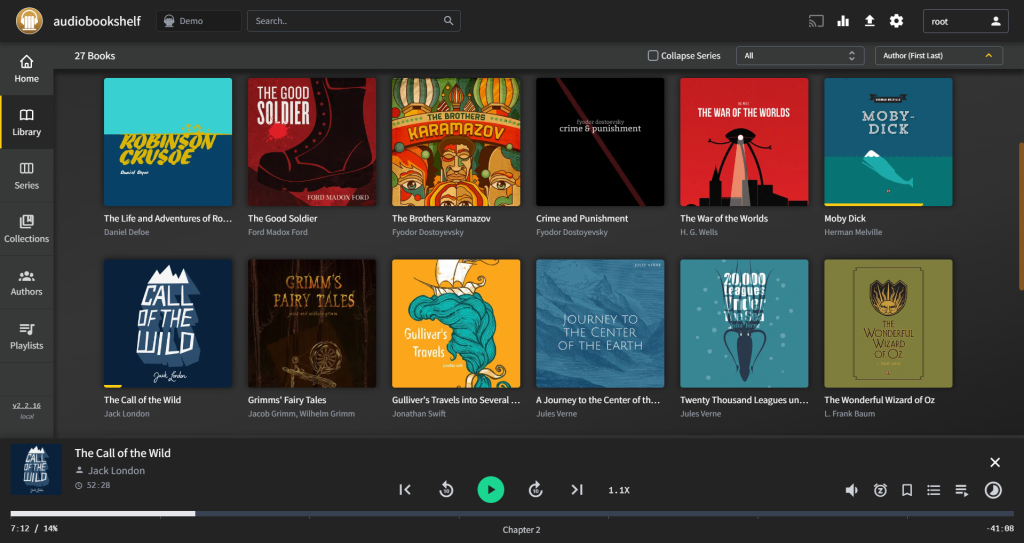
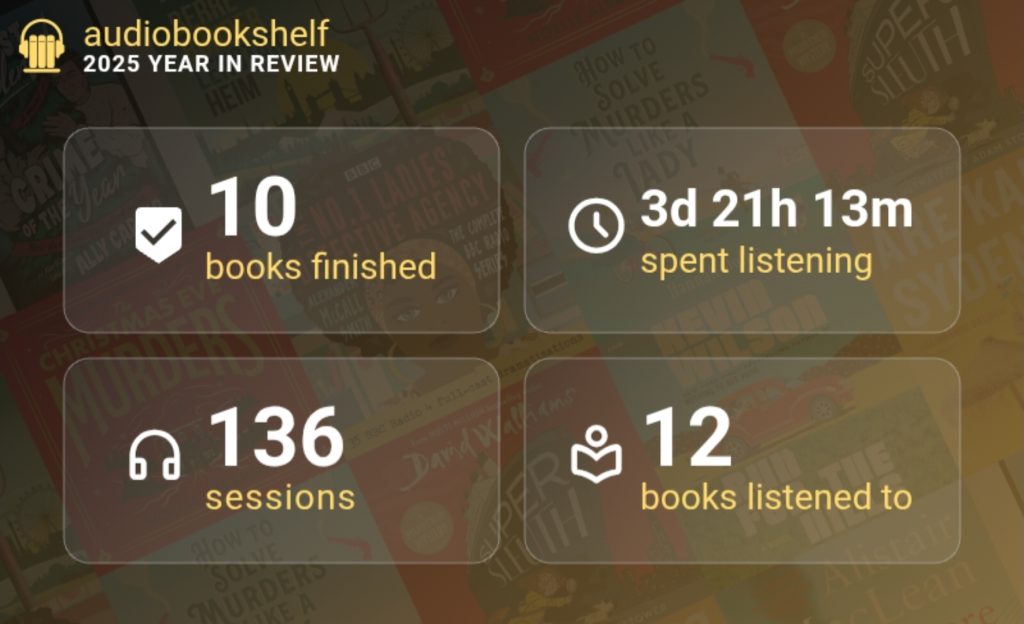
Audiobookshelf was a new one to me, and was easy to install back in August. I host this on a VM at home with a read only mounted network disk from my NAS. Audiobookshelf also offers Podcast handling, but I don’t want to mix those two in the same app, so I have only been using it for audiobooks.I have been using this a lot (on my personal scale). I have nothing negative to say, and have been very happy with it!
On a side note: I buy my DRM free Norwegian audio books at Ark and Norli, and my English books at Libro.fm.
PinePods
PinePods was installed late in the year. It is a Rust based project that offers a gPodder compatible backend and a web front end. It can also sync to an external gPodder backend if you already use something like oPodSync. It also offers desktop and mobile apps, but I will mainly use the web front end and AntennaPod on Android.
I used to use Pocket Casts, which I really liked, but the owner went crazy during the year, so I wanted to rely on something else. I used Antennapod without a backend for a few months and was happy with that. Then I set up a gPodder compatible backend on Nextcloud with plugin, and that worked OK, but this setup is much better.
Immich
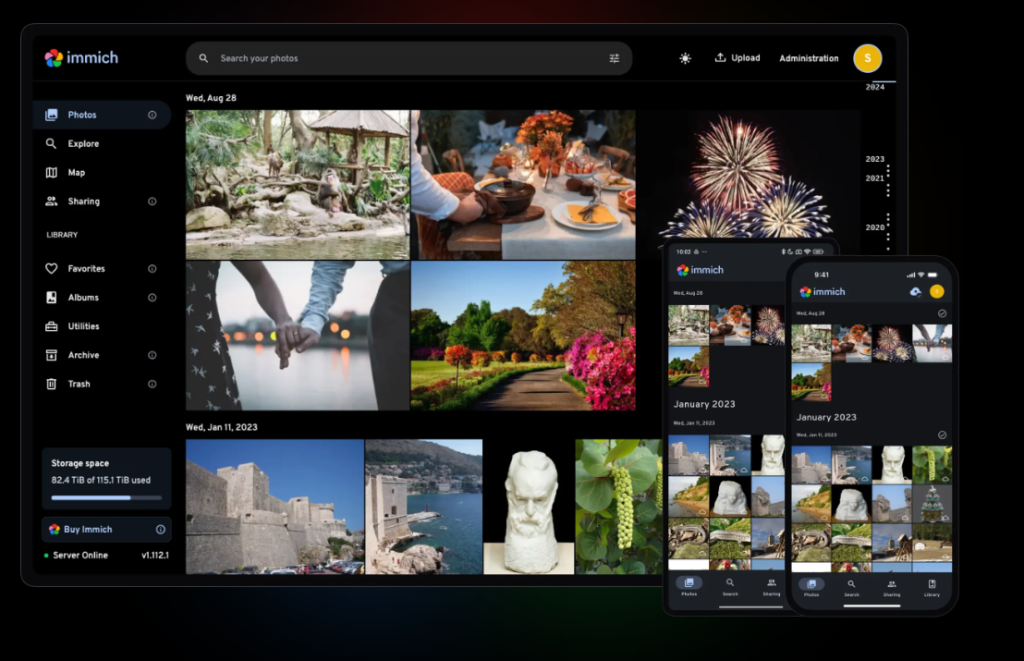
Immich was installed early in 2025 with PikaPods. It has been a really nice experience so far. It works very well, and the search function with local object recognition has been working surprisingly well.The only reason I haven’t deleted my pictures on Google Photo yet, is that I haven’t found a good way to backup the images. I can reach the raw files from the installation, but I want a nicer download with the original file names etc, and I want them synced to my NAS on a daily basis. I have seen python scripts, but haven’t had time to look into it yet. I hope to get that under control in 2026.
FreshRSS
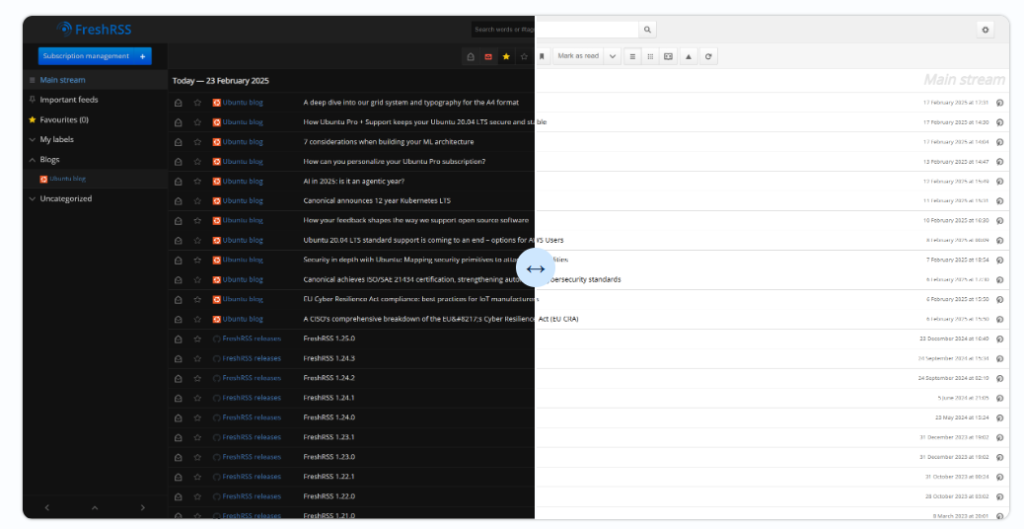
2025 was the year I went back to RSS. I want to follow news sources outside of social media streams (decentralization is good for democracy as someone else does not choose what I should read). One thing is the larger news channels which I visit daily. But not all sites updates daily, especially private blogs. I now check in on FreshRSS daily (hosted with PikaPods).
Forgejo
With all the AI nonsense going on at Github, and as they are owned by Microsoft and hosted on US ground, I wanted an alternative. I have also been using Gitlab. Gitlab offers self hosting, but it is not the easiest to host.
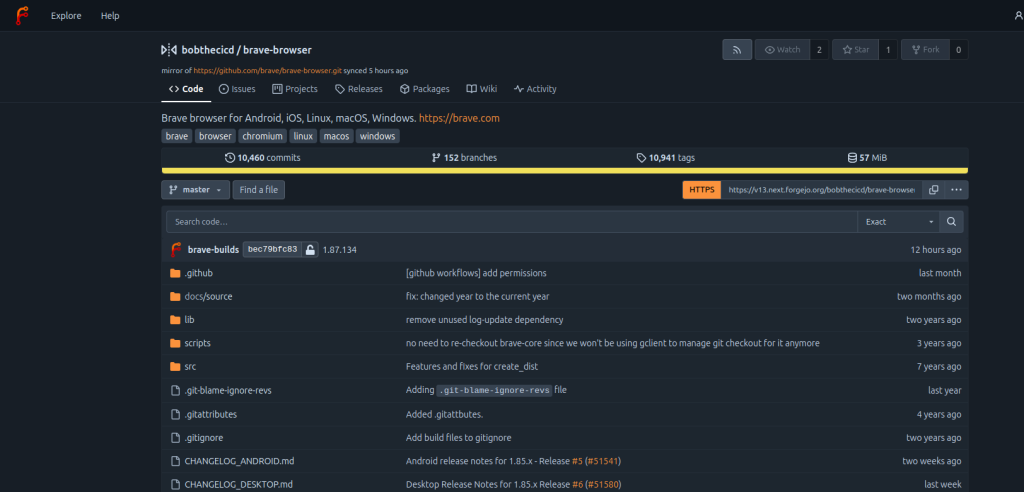
PikaPods offers Forgejo. The one clear down side is that Forgejo on PikaPods does not work with SSH, and I have to rely on HTTPS. That is not ideal, but it works. Self hosting it with docker should not be too hard to set up either.
Forgejo aims to integrate ActivityPub so they can support likes, pull requests etc between hosts. It will take a while before that is ready, but I really like what they aim for. Forgejo is super fast and works very well.
A word on social media
I haven’t been hosting anything for social media. But I have been trying to move to decentralized services. I ditched Twitter before it was renamed to X as it had already started to go up in flames. Facebook has been harder to drop as many of my interest groups are there and it is the one place were I can get in touch with old friends and family. But it is very clear that we need something else than feeds controlled by a large entity that always ends up becoming horrible.
Mastodon is the best alternative for X in my opinion. Bluesky offers a distributed architecture, but in reality it is quite centralized so far. As a company controls the standard too, I think it will be only a matter of time before that becomes a pile of flames too.Mastodon is truly decentralized and based on the AcitivityPub protocol.
Pixelfed offers to the decentralized world of ActivityPub what Instagram does in its closed ecosystem, and I have been using that quite a bit too. More on these services in a later post.
Summary
I will continue to work for self hosting and services on European grounds in 2026. Big tech has gone in the wrong direction for a long time, and hosting in the US is getting a real problem now as the sitting president is doing his best to build down the democracy. I hope for a better year in 2026.
I have for a while wanted to make a new blog. I used to blog many years ago, but stopped when the world moved away from blogs.
Over the last couple of years, my wish to move away from large centralized services has increased. I want to get back the control of my own data. So getting back to blogging made sense.
I don’t expect many readers, and do this as much for myself as for others. But with support for activitypub, who knows? Perhaps I will get a reader or two?